* Indicates required fields

Car Drop Of Selector  
Geolocation


Rental Period:

pickUpDate - dropOffDate

Pick-Up: pickUpTime - Drop-Off: dropOffTime

Edit

Pick-Up Location:

pickUpAddress

pickUpAgencyName

pickUpAgencyAddress

Edit

Drop-Off Location:

Same as Pick-Up Location

dropOffAddress

dropOffAgencyName

dropOffAgencyAddress

Edit

* Indicates required fields

 Checkbox
 Checkbox

* Indicates required fields

 
Room %{=roomIndex} Age of child %{=index}

* Indicates required fields

Cruise Selector  Alaska Cruise Tours Help - Opens a dialog

Cruise Tours:

A cruise tour is a voyage and land tour combination, with the land tour occurring before or after the voyage. Unless otherwise noted, optional services such as airfare, airport transfers, shore excursions, land tour excursions, etc. are not included and are available for an additional cost.

* Indicates required fields

* Indicates required fields

Warning
WarningPackage not available on dates selected. Please enter alternative dates.
 Checkbox  Checkbox
 Checkbox
 Checkbox


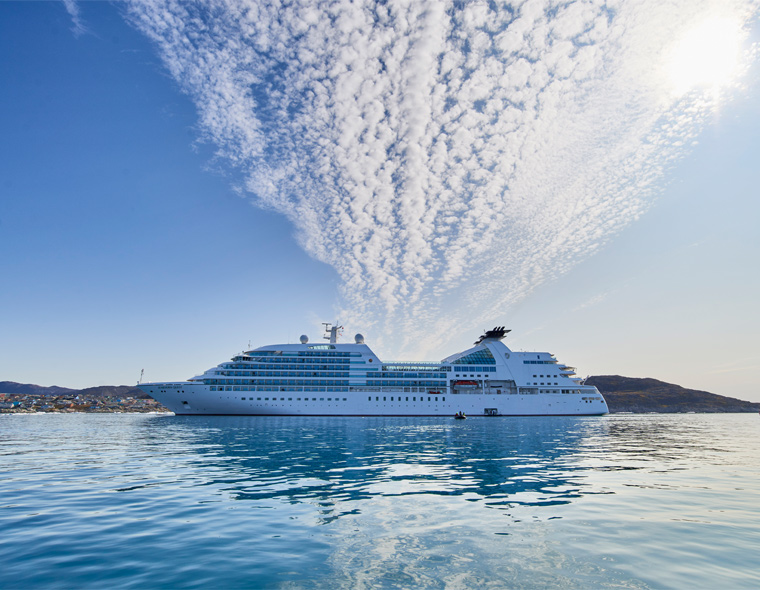
Europe and Mediterranean: Cape to Cape World Cruise: Miami to Dover

 
Seabourn®
Nestled at the foot of Table Mountain and flanked by Devil's Peak and Lion's Head, Cape Town is known by South Africans simply as 'the Cape,' an acknowledgment of its uniqueness and its status as the Mother City. The first area to be settled by Europeans in the 17th century, it is today a major seaport and the legislative capital of South Africa
 
  • All-Inclusive Cruise

    • All onboard gratuities

    • Select complimentary shore excursions**

    • Unlimited beverages, including fine wines and premium spirits served throughout the ship

    • Complimentary dining venues

    • Complimentary in-suite bar

    • Complimentary caviar

    • Complimentary Wi-Fi packages with unlimited minutes

    • Welcome bottle of Champagne

    Icon of the black Costco Wholesale Executive Membership card.

    Executive Member Benefit

    Icon of the black Costco Wholesale Executive Membership card.
    • Executive Members receive an annual 2% Reward, up to $1,250, on qualified Costco Travel purchases

    Icon image of the red Costco Shop Card.

    Digital Costco Shop Card

    Icon image of the red Costco Shop Card.
    • Member Exclusive: Digital Costco Shop Card with every Seabourn® sailing†

Sailing Itinerary

Note: Cruise itineraries are subject to change. Please verify ports and times directly with the cruise line.

Day 1 Port of Call Miami Departure 4:00pm

Overview

The City of Miami known as the “Magic City” is located in Southeast Florida, in Miami-Dade County on the Miami River, between the Florida Everglades and the Atlantic Ocean. Since its incorporation in 1896, the City has grown tremendously, transforming it into one of the world’s renowned centers where people can work, live, and play while enjoying a high quality of life. The City of Miami, known for its diverse culture and ethnicities is the largest municipality in Miami-Dade County. According to the 2000 census, it has a population of 362,470. By the year 2010, the population in the City is projected to rise to 390,191. Miami which is known as the Gateway to Latin America attracts a tremendous amount of foreign-born people, resulting in a large Latin American population that includes Cubans, Nicaraguans, Colombians, Venezuelans, Puerto Ricans, Argentineans, Ecuadorians, Brazilians, Dominicans, Haitians and Mexicans. According to the 2000 U.S. census, the City has a 60 percent Hispanic population, a 22.3 percent African-American population, and an 11.9 percent White/other population.

Day 2 Cruising
Day 3 Cruising
Day 4 Cruising
Day 5 Port of Call Panama Canal Arrival 6:00am Departure 8:00pm

Overview

The Panama Canal is an artificial 48-mile waterway in Panama that connects the Atlantic Ocean with the Pacific Ocean. The canal cuts across the Isthmus of Panama and is a key conduit for international maritime trade. The Canal uses a system of locks -compartments with entrance and exit gates. The locks function as water lifts: they raise ships from sea level (the Pacific or the Atlantic) to the level of Gatun Lake (26 meters above sea level); ships then sail the channel through the Continental Divide. Each set of locks bears the name of the townsite where it was built: Gatun (on the Atlantic side), and Pedro Miguel and Miraflores (on the Pacific side). The lock chambers -steps-- are 33.53 meters wide by 304.8 meters long. The maximum dimensions of ships that can transit the Canal are: 32.3 meters in beam; draft -their depth reaches- 12 meters in Tropical Fresh Water; and 294.1 meters long (depending on the type of ship). The water used to raise and lower vessels in each set of locks come from Gatun Lake by gravity; it comes into the locks through a system of main culverts that extend under the lock chambers from the sidewalls and the center wall. The narrowest portion of the Canal is Culebra Cut, which extends from the north end of Pedro Miguel Locks to the south edge of Gatun Lake at Gamboa. This segment, approximately 13.7 kilometers long, is carved through the rock and shale of the Continental Divide. Ships from all parts of the world transit daily through the Panama Canal. Some 13 to 14 thousand vessels use the Canal every year. Commercial transportation activities through the Canal represent approximately 5% of the world trade. The Canal has a workforce of approximately 9 thousand employees and operates 24 hours a day, 365 days a year, providing transit service to vessels of all nations without discrimination.

Day 5 Port of Call Fuerte Amador Arrival 9:00pm

Overview

Fuerte Amador is a Peninsula jutting out into the Pacific from Balboa. It is separated from Panama City by Ancón Hill and is situated at the Pacific entrance to the Panama Canal. It was built to protect the canal entrance from the Pacific Ocean and is a major port of call for cruise lines. There is also a Marina, the Flamenco Yacht Club.

Day 6 Port of Call Fuerte Amador Departure 4:00pm

Overview

Fuerte Amador is a Peninsula jutting out into the Pacific from Balboa. It is separated from Panama City by Ancón Hill and is situated at the Pacific entrance to the Panama Canal. It was built to protect the canal entrance from the Pacific Ocean and is a major port of call for cruise lines. There is also a Marina, the Flamenco Yacht Club.

Day 7 Cruising
Day 8 Cruising
Day 9 Port of Call Guayaquil Arrival 5:00am Departure 6:00pm

Overview

Guayaquil is a tropical city surrounded by hills as well as situated on the banks of an arm of the ocean and the majestic Guayas River, a setting that will captivate you with its magic of the South Pacific. It is a Renaissance city enjoying a 21st-century urban, cultural, and humanistic renaissance. Highly renowned both in Latin America and the world for its positive transformation, with original and distinctive urban creations, such as its 2 new waterfront attractions, Malecón 2000 and Malecon del Salado, Guayaquil has kilometers of botanic gardens, monuments, theatres, museums, malls and much much more on the banks of its waters and the center of its heart. The spectacular views from its hills such as those of Santa Ana with its new lighthouse, restaurants, craft and souvenir shops, and art galleries constitute yet another symbol of the city´s uniqueness.

Day 10 Cruising
Day 11 Port of Call Salaverry Arrival 5:00am Departure 5:00pm

Overview

Salaverry is located a 30-minute drive from the city of Trujillo. This is the port for Trujillo, the Lordly City, whose elegant mansions and churches reflect the aristocracy of the Spanish colonial era. Here you may opt for a thrilling excursion to Chan, Chan, an immense and magnificent enclave that since A.D. 1300 has been the center of the sophisticated Chim culture.

Day 12 Port of Call Callao Arrival 1:00pm

Overview

Callao is built on and around a peninsula, in the district of La Punta, a wealthy residential neighborhood. A historical fortress, the Castillo de Real Felipe, stands on the promontory overlooking the harbor. A large naval base is located in Callao. Its prison holds Abimael Guzmán, the leader of the Shining Path terrorist organization, and Vladimiro Montesinos, the ex-director of internal security during the Fujimori regime. Jorge Chávez International Airport is located in Callao. On a bluff overlooking the harbor sits Colegio Militar Leoncio Prado, the military high school. The city also has a university, the National University of Callao. The main Naval Hospital, Centro Medico Naval is located on Avenida Venezuela in Bellavista. It contains the U.S. Navy Command Naval Medical Research Unit Six. Residents of Callao are known as chalacos. Callao's professional football teams are Sport Boys and Atlético Chalaco. Callao has several islands: San Lorenzo-currently a military base, El Frontón-a former high-security prison, the Cavinzas Islands, and the Palomino Islands, where numerous sea lions and sea birds live in a virtually untouched ecosystem. There are proposed plans to build a huge naval, terrestrial, and airport on San Lorenzo Island. This project is called the San Lorenzo Megaport Project.

Day 13 Callao

Overview

Callao is built on and around a peninsula, in the district of La Punta, a wealthy residential neighborhood. A historical fortress, the Castillo de Real Felipe, stands on the promontory overlooking the harbor. A large naval base is located in Callao. Its prison holds Abimael Guzmán, the leader of the Shining Path terrorist organization, and Vladimiro Montesinos, the ex-director of internal security during the Fujimori regime. Jorge Chávez International Airport is located in Callao. On a bluff overlooking the harbor sits Colegio Militar Leoncio Prado, the military high school. The city also has a university, the National University of Callao. The main Naval Hospital, Centro Medico Naval is located on Avenida Venezuela in Bellavista. It contains the U.S. Navy Command Naval Medical Research Unit Six. Residents of Callao are known as chalacos. Callao's professional football teams are Sport Boys and Atlético Chalaco. Callao has several islands: San Lorenzo-currently a military base, El Frontón-a former high-security prison, the Cavinzas Islands, and the Palomino Islands, where numerous sea lions and sea birds live in a virtually untouched ecosystem. There are proposed plans to build a huge naval, terrestrial, and airport on San Lorenzo Island. This project is called the San Lorenzo Megaport Project.

Day 14 Port of Call Callao Departure 9:00pm

Overview

Callao is built on and around a peninsula, in the district of La Punta, a wealthy residential neighborhood. A historical fortress, the Castillo de Real Felipe, stands on the promontory overlooking the harbor. A large naval base is located in Callao. Its prison holds Abimael Guzmán, the leader of the Shining Path terrorist organization, and Vladimiro Montesinos, the ex-director of internal security during the Fujimori regime. Jorge Chávez International Airport is located in Callao. On a bluff overlooking the harbor sits Colegio Militar Leoncio Prado, the military high school. The city also has a university, the National University of Callao. The main Naval Hospital, Centro Medico Naval is located on Avenida Venezuela in Bellavista. It contains the U.S. Navy Command Naval Medical Research Unit Six. Residents of Callao are known as chalacos. Callao's professional football teams are Sport Boys and Atlético Chalaco. Callao has several islands: San Lorenzo-currently a military base, El Frontón-a former high-security prison, the Cavinzas Islands, and the Palomino Islands, where numerous sea lions and sea birds live in a virtually untouched ecosystem. There are proposed plans to build a huge naval, terrestrial, and airport on San Lorenzo Island. This project is called the San Lorenzo Megaport Project.

Day 15 Port of Call Puerto General San Martin Arrival 8:00am Departure 6:00pm

Overview

Puerto General San Martin is a port in the middle of nowhere adjacent to the desert of Ica and the National Park of Paracas. Bird watchers and wildlife lovers can experience nirvana at the photogenic Paracas National Reserve and the Ballestas Islands; this is also your chance to fly over the vast, fragile symbols of the Nazca Lines.

Day 16 Cruising
Day 17 Cruising
Day 18 Cruising
Day 19 Cruising
Day 20 Cruising
Day 21 Port of Call Easter Island/Rapa Nui Arrival 8:00am

Overview

Easter Island is over 2,000 miles from the nearest population center, (Tahiti and Chile), making it one of the most isolated places on Earth. A triangle of volcanic rock in the South Pacific - it is best known for the giant stone monoliths, known as Moai, that dot the coastline. The early settlers called the island "Te Pito O Te Henua" (Navel of The World). Admiral Roggeveen, who came upon the island on Easter Day in 1722, named it Easter Island. Today, the land, people, and language are all referred to locally as Rapa Nui. There has been much controversy and confusion concerning the origins of the Easter Islanders. Thor Heyerdahl proposed that the people who built the statues were of Peruvian descent, due to a similarity between Rapa Nui and Incan stonework. Some have suggested that Easter Island is the remnant of a lost continent or the result of an extra-terrestrial influence. Archaeological evidence, however, indicates the discovery of the island by Polynesians at about 400 AD - led, according to legend, by Hotu Matua. Upon their arrival, an impressive and enigmatic culture began to develop. In addition to the statues, the islanders possessed the Rongorongo script; the only written language in Oceania. The island is also home to many petroglyphs (rock carvings), as well as traditional wood carvings, tapa (barkcloth) crafts, tattooing, string figures, dance and music. The population of Easter Island reached its peak at perhaps more than 10,000, far exceeding the capabilities of the small island's ecosystem. Resources became scarce, and the once lush palm forests were destroyed - cleared for agriculture and moving the massive stone Moai. In this regard, Easter Island has become, for many, a metaphor for ecological disaster. Thereafter, a thriving and advanced social order began to decline into bloody civil war and, evidently, cannibalism. Eventually, all of the Moai standing along the coast were torn down by the islanders themselves. All of the statues now erected around the island are the result of recent archaeological efforts. Contacts with western "civilization" proved even more disastrous for the island population which, through slavery and disease, had decreased to approximately 111 by the turn of the century. Following the annexation by Chile in 1888, however, it has risen to more than 2,000, with other Rapanui living in Chile, Tahiti, and North America. Despite a growing Chilean presence, the island's Polynesian identity is still quite strong. Easter Island today remains one of the most unique places you will ever encounter; an open-air museum showcasing a fascinating, but unfortunately lost, culture. The Rapanui are among the friendliest people you will ever meet, and the landscape is truly amazing - with its volcanic craters, lava formations, beaches, brilliant blue water, and archaeological sites. Lan Chile flies to Easter Island, with flights operating between Santiago, Chile, and Papeete, Tahiti. Airfare from Santiago, Chile to Easter Island and back costs approximately $800 US. Several companies can arrange package trips, including hotels, tours, etc., but it is possible, and much cheaper, to arrange a place to stay upon arrival. Many locals who operate hotels and guesthouses arrive at Mataveri Airport to greet the tourists and this is something you might consider. Staying in a private home is a great way to meet the islanders and experience the local culture; however, one should use judgment in choosing accommodations, as not all places are of equal quality. Notably, the tourism on Easter Island is run entirely by the Rapanui themselves. In late January to early February, the islanders celebrate Tapati, a festival honoring the Polynesian cultural heritage of the island. Far Horizons Archaeological and Cultural Tours organizes tours to the festival.

Day 22 Port of Call Easter Island/Rapa Nui Departure 6:00pm

Overview

Easter Island is over 2,000 miles from the nearest population center, (Tahiti and Chile), making it one of the most isolated places on Earth. A triangle of volcanic rock in the South Pacific - it is best known for the giant stone monoliths, known as Moai, that dot the coastline. The early settlers called the island "Te Pito O Te Henua" (Navel of The World). Admiral Roggeveen, who came upon the island on Easter Day in 1722, named it Easter Island. Today, the land, people, and language are all referred to locally as Rapa Nui. There has been much controversy and confusion concerning the origins of the Easter Islanders. Thor Heyerdahl proposed that the people who built the statues were of Peruvian descent, due to a similarity between Rapa Nui and Incan stonework. Some have suggested that Easter Island is the remnant of a lost continent or the result of an extra-terrestrial influence. Archaeological evidence, however, indicates the discovery of the island by Polynesians at about 400 AD - led, according to legend, by Hotu Matua. Upon their arrival, an impressive and enigmatic culture began to develop. In addition to the statues, the islanders possessed the Rongorongo script; the only written language in Oceania. The island is also home to many petroglyphs (rock carvings), as well as traditional wood carvings, tapa (barkcloth) crafts, tattooing, string figures, dance and music. The population of Easter Island reached its peak at perhaps more than 10,000, far exceeding the capabilities of the small island's ecosystem. Resources became scarce, and the once lush palm forests were destroyed - cleared for agriculture and moving the massive stone Moai. In this regard, Easter Island has become, for many, a metaphor for ecological disaster. Thereafter, a thriving and advanced social order began to decline into bloody civil war and, evidently, cannibalism. Eventually, all of the Moai standing along the coast were torn down by the islanders themselves. All of the statues now erected around the island are the result of recent archaeological efforts. Contacts with western "civilization" proved even more disastrous for the island population which, through slavery and disease, had decreased to approximately 111 by the turn of the century. Following the annexation by Chile in 1888, however, it has risen to more than 2,000, with other Rapanui living in Chile, Tahiti, and North America. Despite a growing Chilean presence, the island's Polynesian identity is still quite strong. Easter Island today remains one of the most unique places you will ever encounter; an open-air museum showcasing a fascinating, but unfortunately lost, culture. The Rapanui are among the friendliest people you will ever meet, and the landscape is truly amazing - with its volcanic craters, lava formations, beaches, brilliant blue water, and archaeological sites. Lan Chile flies to Easter Island, with flights operating between Santiago, Chile, and Papeete, Tahiti. Airfare from Santiago, Chile to Easter Island and back costs approximately $800 US. Several companies can arrange package trips, including hotels, tours, etc., but it is possible, and much cheaper, to arrange a place to stay upon arrival. Many locals who operate hotels and guesthouses arrive at Mataveri Airport to greet the tourists and this is something you might consider. Staying in a private home is a great way to meet the islanders and experience the local culture; however, one should use judgment in choosing accommodations, as not all places are of equal quality. Notably, the tourism on Easter Island is run entirely by the Rapanui themselves. In late January to early February, the islanders celebrate Tapati, a festival honoring the Polynesian cultural heritage of the island. Far Horizons Archaeological and Cultural Tours organizes tours to the festival.

Day 23 Cruising
Day 24 Cruising
Day 25 Cruising
Day 26 Cruising
Day 27 Port of Call Robinson Crusoe Arrival 9:00am Departure 7:00pm

Overview

This Island belongs to the Juan Fernandez Archipelago, which has been a passing place for explorers and sailors, a hiding place for pirates and their treasures, a shelter for Alexander Selkirk, the sailor who inspired the Robinson Crusoe novel, and a prison during the Chilean Independence War. It is a National Park and Unesco World Biosphere Reserve. Robinson Crusoe Island, separated from Valparaiso by 670 km of the open Pacific Ocean, is not a major holiday destination. The archipelago consists of three islands with extraordinary rugged and mountainous topography, and distinctly Mediterranean climate. Rainfall varies greatly over very short distances, allowing dense rainforest with many endemic species, in contrast with other Atacama-like areas. The island has a population of 500 inhabitants, for whom fishing is the main activity. Transportation to the island consists of two and a half hours flight from Santiago by private charter flight two-engine aircraft). The accommodations are not luxurious, but in beautiful locations, mainly consisting of small hostels and cabins.

Day 28 Port of Call Santa Clara Island Arrival 8:00am Departure 6:00pm

Overview

Santa Clara Island is a tiny, uninhabited island in the Pacific Ocean, off the coast of Robinson Crusoe Island in a group of islands known as the Juan Fernández Islands. The island is of volcanic origin and is approximately 1 km long and 0.6 km wide

Day 29 Cruising
Day 30 Port of Call Valparaiso Arrival 7:00am Departure 3:00pm

Overview

The second-largest city in Chile, Valparaíso enjoys a spectacular location between the mountains and the sea. This coastal city boasts a romantic, time-worn elegance of cobbled streets and Victorian houses. The Chilean Congress recently moved to Valparaíso from Santiago, giving the city a fresh boost of energy. Just ten minutes north of Valparaíso lies Vina del Mar, Chile's premier coastal resort. You'll find fabulous beaches and a bustling commercial sector. Viña del Mar is known as the Ciudad Jardín (Garden City) thanks to its lavish gardens and subtropical atmosphere. The weather is often cool and foggy. The nightlife is better in Vina del Mar than in Valparaíso, so plan to head there to check out the cinemas and dance clubs.Near these twin cities are loads of beaches and stunning coastlines. Be sure to check out the fabulous seafood. The Reserva Nacional Lago Penuelas near Valparaiso is a popular spot for weekend outings. The Parque Nacional la Campana is a great place for communing with the outdoors as well.

Day 31 Cruising
Day 32 Port of Call Puerto Montt Arrival 10:00am Departure 8:00pm

Overview

This is the capital city of the Lakes Region X, the last city in its longitudinal valley. Puerto Montt was founded in 1853 by Vicente Perez Rosales as part of the policy of settling the area promoted by the government of the time. A year before, the first German immigrants to the country had arrived in the area, and the city, along with Valdivia and Osorno, retains much of their influence. The bay of Puerto Montt extends over the northern part of the Seno de Reloncavi, with a view of the distant Corcovado and Michinmahuida volcanoes. The central business and service section of the city lies around Manuel Irrazabal Square, with a nice view of the sea, and the Cathedral located north of the square. From the square westwards is the John Paul II Museum, which commemorates the visit of His Holiness the Pope in 1987, as well as housing articles from the culture of the indigenous peoples and the German settlers. Further on rise the harbor works and the Handicrafts Fair, where a variety of characteristic articles produced by local artists can be seen and purchased. At the end of the street is the Caleta Angelmo, famous for its fair and traditional restaurants, especially those where every sort of fish and seafood, in particular the local "curanto," can be sampled. Along the same coast road eastwards of the city is Pelluco Beach, with its beautiful residences, very good restaurants, discotheques, and pubs.

Day 33 Port of Call Castro Arrival 7:00am Departure 4:00pm

Overview

Castro is a city on Chiloé Island in Chile's Lake District. Colorful wooden stilt houses line the waterfront. On Plaza de Armas, the yellow, early-20th-century San Francisco Church has 2 steeples and a distinctive wooden interior. Nearby, woven baskets are sold at the craft fair. The Museum of Modern Art Chiloé displays works by Chilean artists. To the west, Chiloé National Park is home to sea lions.

Day 33 Corcovado Gulf

Overview

The Gulf of Corcovado (Spanish: Golfo de Corcovado) is a large body of water separating Chiloé Island from the mainland of Chile. Geologically it is a foreland basin that has been carved out by Quaternary glaciers. A large population of blue whales is found there, and it is under threat from salmon farming.

Day 34 Port of Call Puerto Chacabuco Arrival 10:00am Departure 7:00pm

Overview

Situated along the wild-west fjordland coast of Chile, 250 miles south of Puerto Montt, it is here that the northern Patagonian ice sheets fall into the sea in neon blue splendor. One of the last frontiers, there are few such remote, unspoiled, and underdeveloped places left on earth. To simply admire the pristine beauty of its untouched natural resources is the main reason for calling on this port. Puerto Chacabuco is a small isolated settlement with no clearly defined town center. The town itself consists of one main road, a fish processing facility, and a pier. A frontier-like village, about 10 miles north of the port, Puerto Aysen, is the area's main town.

Day 35 Cruising
Day 36 Wide Channel

Overview

Wide Channel is an inside passage of the Chilean Patagonia. It is 38 miles long, extending northward from the junction of Concepción Channel and Trinidad Channel to Saumarez Island.

Day 36 Seno Eyre Fjord

Overview

Lying on Chile's beautiful stretch of southern coastline, Seno Eyre Fjord is a deep valley, terraced by walls of rich jungle greenery.

Day 36 Port of Call Pio XI Glacier Arrival 8:00am Departure 6:00pm

Overview

Discover the Pio XI Glacier, the largest glacier in the southern hemisphere, a real giant 6 kilometers wide and towers above, standing some 75 meters tall, with a length of 64 kilometers.

Day 37 Peel Fjord

Overview

Peel Fjord is a fjord in Chile. It branches off from the Sarmiento Channel and is located at. The east side of the fjord has three side fjords, named Amalia, Asia and Calvo.

Day 37 Port of Call El Brujo Glacier Arrival 7:00am Departure 9:00am

Overview

Glaciar El Brujo is an impressive and magnificent glacier located at the end of Fiordo Asia. Glaciar El Brujo is an enormous ice wall that fascinates the traveler. For this tour, we will lower our excursion boats and approach the site, to disembark on an incomplete magmatic rock, which volcanologists call “garbo”. On going ashore we walk on the rock, which is rather slippery when it rains, but is like walking on sandpaper in good weather so that our shoes manage to get a good grip.

Day 37 Sarmiento Channel

Overview

Sarmiento Channel is a principal Patagonia channel, which extends in a north-south direction. It begins with the Guia Narrows (Angostura Guia) and is located in Magallanes y Antártica Chilena Region. The kawesqar people sailed its waters from around 6,000 years ago until end of 20th century, as they inhabited its coasts. The channel is named after Pedro Sarmiento de Gamboa, who was a Spanish explorer who navigated the region's waterways between 1579 and 1580.

Day 38 Magellan Strait

Overview

Magellan, Strait of, c.330 mi (530 km) long and 2 1/2 to 15 mi (4–24 km) wide, separating South America from Tierra del Fuego and other islands south of the continent. Except for a few miles at its eastern end in Argentina, it passes through Chile. The strait, discovered by Ferdinand Magellan in 1520, was important in the days of sailing ships, especially before the building of the Panama Canal, and is still used by ships rounding South America. One of the most scenic waterways in the world, it affords an inland passage protected from almost continuous ocean storms. However, the strait is often foggy. The only city on the strait is Punta Arenas on Tierra del Fuego.

Day 38 Port of Call Punta Arenas Arrival 10:00am Departure 11:00pm

Overview

This is Patagonia's largest and most commercially important city. Located on the western side of the Strait of Magellan with a superb port and the only large airport in the area, it is the major hub for boat transport through the strait and research vessels on their way to or from Antarctica. For the visitor, Punta Arenas is better known as the gateway to Torres del Paine National Park, 400 kilometers to the northwest. This unique town grew up on wool and international shipping before the Panama Canal opened. In the late 19th century, huge fortunes made by sheep farming left the city with distinguished mansions, some of them now museums and other monuments. Summer cruise ships from Punta Arenas travel to Antarctica, where Chile claims a sector of the icebound continent. You can also begin a scenic ferry cruise through the Chilean fjords from Puerto Natales, sailing north to Puerto Montt, in the southern mainland lake region.

Day 39 Cruising
Day 40 Port of Call Garibaldi Glacier Arrival 7:00am Departure 5:00pm

Overview

Garibaldi Glacier is undoubtedly one of the visual highlights of Patagonia. The setting is magical and surreal with sheer cliffs of up to 600 meters and streaming waterfalls and glacial ice. The bay is laced with thousands of chunks of floating ice that have dislodged from the glacier. One can stop to observe at close range a thriving colony of sea lions enjoying life in their frozen kingdom.

Day 41 Port of Call Ushuaia Arrival 8:00am Departure 7:00pm

Overview

Ushuaia is the southernmost city in the world, on the shores of the Beagle Channel and surrounded by the Martial Mounts. It is the capital of the Tierra del Fuego, Antarctica, and Southern Atlantic Islands Province, and its superlative location allows you to enjoy the sea, mountains, and forests at the same time. Besides, it is a great place for shopping: the whole island is a tax-free zone, thus you can find lots of imported goods along with regional products.

Day 42 Cruising
Day 43 Cruising
Day 44 Port of Call Antarctica Arrival 7:00am Departure 5:00pm

Overview

Antarctica is the fifth largest continent and is asymmetrically centered on the South Pole and almost entirely within the Antarctic Circle. Antarctica consists of two major regions: W Antarctica (c.2,500,000 sq mi/6,475,000 sq km), a mountainous archipelago that includes the Antarctic Peninsula, and E Antarctica (c.3,000,000 sq mi/7,770,000 sq km), geologically a continental shield. They are joined into a single continental mass by an ice sheet thousands of feet thick. At the seaward margins of the ice sheet masses of ice break off and float away as icebergs, leaving ice cliffs. Where the outward creep of the ice is channeled into ice streams (zones of more rapid flow), great floating ice tongues project into the sea; where mountains retard outward movement, the flow is channeled into great valley glaciers. Less than 5% of Antarctica is free of ice; these areas include mountain peaks, arid dry valleys, small coastal areas, and islands. There is no native human population in Antarctica, nor are there any large land animals. Few species are adapted to the antarctic environment, but individuals of these few species are numberless.

Day 45 Port of Call Antarctica Arrival 7:00am Departure 5:00pm

Overview

Antarctica is the fifth largest continent and is asymmetrically centered on the South Pole and almost entirely within the Antarctic Circle. Antarctica consists of two major regions: W Antarctica (c.2,500,000 sq mi/6,475,000 sq km), a mountainous archipelago that includes the Antarctic Peninsula, and E Antarctica (c.3,000,000 sq mi/7,770,000 sq km), geologically a continental shield. They are joined into a single continental mass by an ice sheet thousands of feet thick. At the seaward margins of the ice sheet masses of ice break off and float away as icebergs, leaving ice cliffs. Where the outward creep of the ice is channeled into ice streams (zones of more rapid flow), great floating ice tongues project into the sea; where mountains retard outward movement, the flow is channeled into great valley glaciers. Less than 5% of Antarctica is free of ice; these areas include mountain peaks, arid dry valleys, small coastal areas, and islands. There is no native human population in Antarctica, nor are there any large land animals. Few species are adapted to the antarctic environment, but individuals of these few species are numberless.

Day 46 Port of Call Antarctica Arrival 7:00am Departure 5:00pm

Overview

Antarctica is the fifth largest continent and is asymmetrically centered on the South Pole and almost entirely within the Antarctic Circle. Antarctica consists of two major regions: W Antarctica (c.2,500,000 sq mi/6,475,000 sq km), a mountainous archipelago that includes the Antarctic Peninsula, and E Antarctica (c.3,000,000 sq mi/7,770,000 sq km), geologically a continental shield. They are joined into a single continental mass by an ice sheet thousands of feet thick. At the seaward margins of the ice sheet masses of ice break off and float away as icebergs, leaving ice cliffs. Where the outward creep of the ice is channeled into ice streams (zones of more rapid flow), great floating ice tongues project into the sea; where mountains retard outward movement, the flow is channeled into great valley glaciers. Less than 5% of Antarctica is free of ice; these areas include mountain peaks, arid dry valleys, small coastal areas, and islands. There is no native human population in Antarctica, nor are there any large land animals. Few species are adapted to the antarctic environment, but individuals of these few species are numberless.

Day 47 Port of Call Antarctica Arrival 7:00am Departure 5:00pm

Overview

Antarctica is the fifth largest continent and is asymmetrically centered on the South Pole and almost entirely within the Antarctic Circle. Antarctica consists of two major regions: W Antarctica (c.2,500,000 sq mi/6,475,000 sq km), a mountainous archipelago that includes the Antarctic Peninsula, and E Antarctica (c.3,000,000 sq mi/7,770,000 sq km), geologically a continental shield. They are joined into a single continental mass by an ice sheet thousands of feet thick. At the seaward margins of the ice sheet masses of ice break off and float away as icebergs, leaving ice cliffs. Where the outward creep of the ice is channeled into ice streams (zones of more rapid flow), great floating ice tongues project into the sea; where mountains retard outward movement, the flow is channeled into great valley glaciers. Less than 5% of Antarctica is free of ice; these areas include mountain peaks, arid dry valleys, small coastal areas, and islands. There is no native human population in Antarctica, nor are there any large land animals. Few species are adapted to the antarctic environment, but individuals of these few species are numberless.

Day 48 Port of Call Antarctica Arrival 7:00am Departure 5:00pm

Overview

Antarctica is the fifth largest continent and is asymmetrically centered on the South Pole and almost entirely within the Antarctic Circle. Antarctica consists of two major regions: W Antarctica (c.2,500,000 sq mi/6,475,000 sq km), a mountainous archipelago that includes the Antarctic Peninsula, and E Antarctica (c.3,000,000 sq mi/7,770,000 sq km), geologically a continental shield. They are joined into a single continental mass by an ice sheet thousands of feet thick. At the seaward margins of the ice sheet masses of ice break off and float away as icebergs, leaving ice cliffs. Where the outward creep of the ice is channeled into ice streams (zones of more rapid flow), great floating ice tongues project into the sea; where mountains retard outward movement, the flow is channeled into great valley glaciers. Less than 5% of Antarctica is free of ice; these areas include mountain peaks, arid dry valleys, small coastal areas, and islands. There is no native human population in Antarctica, nor are there any large land animals. Few species are adapted to the antarctic environment, but individuals of these few species are numberless.

Day 49 Cruising
Day 50 Cruising
Day 51 Port of Call Falkland Islands/Malvinas Arrival 7:00am Departure 5:00pm

Overview

Since 1833 the people of the Falkland Islands have been sure of their British identity, but whether you regard them as a detached part of the British Isles in the South Atlantic, or as a part of South America, that suffers from European delusions, you can be assured of encountering ‘a world of difference’ here. From the minute you arrive, the Falklands offers you total personal security, clean air, friendly people, no crowds, no neon, no fast food, and no stress. All this in surroundings where the vastness of the sky is only matched by the distance of the horizon and the eye is constantly captivated by the ever-changing play of light on water and white grass. This is a land where nature is sovereign and mankind is in the minority. Comfortable tourist lodges in remote locations and holiday cottages on island farms give, to a privileged few each year, incomparable opportunities to see at close quarters some of the millions of seabirds and mammals that breed in the Falklands: black-browed albatross, giant petrels, five kinds of penguin, elephant seals, sea lions, striated caracara, crested caracara, night heron ......... the list goes on. And then there’s the fly-fishing for sea trout up to a record of over 20 lbs. Direct flights from South America by LanChile, the Chilean national airline, together with the long-running direct RAF service from Brize Norton in Oxfordshire, England make this "world of difference" more accessible than ever before.

Day 52 Port of Call Falkland Islands/Malvinas Arrival 7:00am Departure 5:00pm

Overview

Since 1833 the people of the Falkland Islands have been sure of their British identity, but whether you regard them as a detached part of the British Isles in the South Atlantic, or as a part of South America, that suffers from European delusions, you can be assured of encountering ‘a world of difference’ here. From the minute you arrive, the Falklands offers you total personal security, clean air, friendly people, no crowds, no neon, no fast food, and no stress. All this in surroundings where the vastness of the sky is only matched by the distance of the horizon and the eye is constantly captivated by the ever-changing play of light on water and white grass. This is a land where nature is sovereign and mankind is in the minority. Comfortable tourist lodges in remote locations and holiday cottages on island farms give, to a privileged few each year, incomparable opportunities to see at close quarters some of the millions of seabirds and mammals that breed in the Falklands: black-browed albatross, giant petrels, five kinds of penguin, elephant seals, sea lions, striated caracara, crested caracara, night heron ......... the list goes on. And then there’s the fly-fishing for sea trout up to a record of over 20 lbs. Direct flights from South America by LanChile, the Chilean national airline, together with the long-running direct RAF service from Brize Norton in Oxfordshire, England make this "world of difference" more accessible than ever before.

Day 53 Port of Call Stanley/Falklands Arrival 7:00am Departure 5:00pm

Overview

Stanley is a picturesque town of about 1700 people. Brightly colored wriggly-tin roofs contrast strikingly with the grays and browns of the surrounding hills. The town is named after Lord Stanley, Secretary of State for the Colonies 1841 - 1844. He ordered the main settlement to be removed from Port Louis to the Port Jackson area and Governor Richard Clement Moody completed the move and took up official residence in Stanley on the 15th July 1844. Your first point of call should be the newly completed Jetty Center - situated just off the Public Jetty, this is where you'll get all the information you'll need on what to do, how to get about, and where to stay. For anyone interested in history, a visit to Stanley will be a rich and rewarding experience. A maritime history trail around the harbor leads you to famous wrecks. Old stone cottages mingle with wriggly-tin houses - there are the amazing Jubilee Villas - a piece of British Victorian suburbia in the South Atlantic and the Chelsea Pensioners houses in Pioneer row (brought here in the late1840ss). There are also more recent reminders of the conflict in 1982 - Stanley may be small but it is filled with interest. Your visit would not be complete without a visit to the museum in Holdfast Road (so called because it was here on the 14th June 1982 that Maj. Gen. Sir Jeremy Moore ordered his troops to 'hold fast' until he had negotiated the Argentine surrender. The museum is packed with a huge variety of exhibits ranging from an 1896 Symphonium to whalebones. The stated objective of the museum is to present a taste of the many aspects of the Falklands' rich and varied history including Domestic, Maritime, Social, Military, and Natural History - it is not to be missed!

Day 54 Cruising
Day 55 Cruising
Day 56 Cruising
Day 57 Port of Call Montevideo Arrival 7:00am Departure 4:00pm

Overview

Home to almost 50% of the nation's population, Montevideo is a modern metropolis with a historical old town dating back to colonial times. Surrounding the whole city lies an uninterrupted stretch of white sandy beach. Highlights include Ciudad Vieja (Old Town) with its 18th-century buildings, the vibrant Mercado del Puerto, and the bustling commercial activity of Avenida 18 de Julio and its cultural offerings (theatres, museums, and art galleries)

Day 58 Port of Call Buenos Aires Arrival 7:00am

Overview

This fabulous city is renowned for its sophistication, although travelers expecting a more 'South American' experience are sometimes disappointed with its European feel. Argentina is one Latin American country where Europeans and North Americans can feel at ease and travel relatively inconspicuously. An interest in soccer and some nimble foot skills may be all you need to feel like a local.

Day 59 Port of Call Buenos Aires Departure 5:00pm

Overview

This fabulous city is renowned for its sophistication, although travelers expecting a more 'South American' experience are sometimes disappointed with its European feel. Argentina is one Latin American country where Europeans and North Americans can feel at ease and travel relatively inconspicuously. An interest in soccer and some nimble foot skills may be all you need to feel like a local.

Day 60 Cruising
Day 61 Cruising
Day 62 Cruising
Day 63 Cruising
Day 64 Cruising
Day 65 Cruising
Day 66 Inaccessible Island

Overview

Inaccessible Island is an extinct volcano with Cairn Peak reaching 449 m. The island is 14 km² in area, rising out of the South Atlantic Ocean 45 km south-west of Tristan da Cunha.

Day 66 Port of Call Tristan da Cunha Island Arrival 8:00am Departure 6:00pm

Overview

Tristan and its uninhabited neighbors - Inaccessible, Nightingale, Stoltenhoff, and Middle Islands - are tips of a gigantic underwater volcano that erupted to break the surface of the Atlantic one million years ago. Situated on the island's only low-lying flat plateau, lies Edinburgh, the island's only settlement: home to 7 families, numbering some 300 people. Jammed between the constant stormy sea and the steeply sloping side of the 2000 m high (6,760 feet) volcano, it's no surprise that there is neither an airport nor a harbor. Indeed the only way to get to the island is when in calmer seas, Tristan's fishing boats approach one of the few container or ice-breaking ships that pass during the year, bringing much-needed food and medical supplies.

Day 67 Port of Call Nightingale Island Arrival 7:00am Departure 5:00pm

Overview

Nightingale Island is an island in the South Atlantic Ocean, 3 km² in area, part of the Tristan da Cunha group of islands. They are administered by the United Kingdom as part of the overseas territory of Saint Helena, Ascension, and Tristan da Cunha. Nightingale Island is part of the Nightingale Islands, which also include the islets of Middle Island and Stoltenhoff Island. All three are uninhabited but are regularly visited for scientific purposes and research.

Day 68 Cruising
Day 69 Cruising
Day 70 Cruising
Day 71 Cruising
Day 72 Cruising
Day 73 Cruising
Day 74 Port of Call Richards Bay Arrival 7:00am Departure 5:00pm

Overview

Richards Bay is a town in KwaZulu-Natal, South Africa. It is situated on a 30 square kilometer lagoon of the Mhlatuze River, which gives it one of the country's largest harbors.

Day 75 Port of Call Maputo Arrival 12:00pm Departure 9:00pm

Overview

Maputo is situated on a large natural bay on the Indian Ocean, near where the rivers Tembe, Mbuluzi, Matola, and Infulene converge. The city consists of seven administrative divisions, which are each subdivided into quarters or bairros. The city is surrounded by Maputo Province but has been administered as a self-contained, separate province since 1998. Maputo City is the geographically smallest and most densely populated province in Mozambique.M aputo is a cosmopolitan city, with Bantu, Portuguese, and to a lesser extent, Arabic, Indian, and Chinese, languages and cultures present.

Day 76 Cruising
Day 77 Port of Call Durban Arrival 7:00am Departure 9:00pm

Overview

Durban is the perfect convention destination. Since being sighted by Vasco da Gama in 1497, its natural harbor has given birth to a vibrant, go-ahead, and ever-changing city. Apart from having the busiest harbor in Africa, Durban is served by its international airport only 15 minutes from its Central Business District. The attractive Yacht basin near the hub continues to provide anchorage and a haven for sailors from around the globe. Durban is an ideal base from which to explore the beauty and splendors of Southern Africa. Within two hours you could be on a safari at one of the country's renowned game reserves - home to some of the world's rarest and most exotic species - or you could be in the fairest Cape. Ninety minutes by road and you could be hiking or trout fishing in the magnificent Drakensberg mountains. Other options - a day or two away could put you amid a miraculous flower transformation in the Namaqualand Desert, or at the origins of man in the Sterkfontein Caves. You could be etched into memory the glorious sunsets and campfires of the Kruger National Park, or the majesty of the Victoria Falls. There are many faces to Durban - a city of great beauty and cultural diversity where you can witness the Dance of the Virgins, a Zulu war dance, and attend a performance of the ballet or Opera all on the same day. The only constant is the famous South African weather - and Durban can serve up the best of it, with an average of 320 sunny days a year. A surfer's paradise and international holiday mecca. Mile upon mile of unspoiled, sun-soaked beaches, bronzed lifeguards, and bikini beauties. Seagulls, pelicans, and exotic birds. Colorful rickshas, beautiful parks, sidewalk cafes, and restaurants. Here architecture encapsulates the diverse histories and cultures of the people. Graceful Victorian buildings, exotic temples, and dignified mosques all stand side by side. Accommodation is plentiful in the Sunshine City, with over 7200 ranging from luxury, tourist, and budget hotels, to all well-appointed serviced apartments, many of which are on the beachfront overlooking the Indian Ocean. Centrally situated and within walking distance of all this, is the International Convention Centre - Durban.

Day 78 Cruising
Day 79 Port of Call Port Elizabeth/South Africa Arrival 6:00am Departure 5:00pm

Overview

Port Elizabeth is a city on Algoa Bay in South Africa's Eastern Cape Province. A major port, it's also known for its numerous beaches. The Donkin Heritage Trail takes in the Old Hill neighborhood's Victorian landmarks. Coastal boat tours spot whales and rare seabirds, while wildlife reserves outside the metropolitan area are home to elephants, rhinos, and other big game.

Day 80 Port of Call Mossel Bay Arrival 9:00am Departure 8:00pm

Overview

Mossel Bay is a harbor town of about 60,000 people on the Southern Cape of South Africa. It is an important tourism and farming region of the Western Cape Province.

Day 81 Cruising
Day 82 Port of Call Cape Town Arrival 6:45am

Overview

The cityscape of Cape Town reflects a history rich in contrasts: governors and slaves, reformers and missionaries, empire builders and ordinary people who became extraordinary role models for a new democratic nation. Beside soaring modern blocks of glass and steel in the city centre, historic buildings - preserved and restored to their former glory - bear testimony to this past. The oldest existing building in South Africa, the Castle was built in 1666 to protect the new settlement at the Cape. Still operational as a military base, today its five imposing stone walls also house a museum with artifacts dating back to the 17th century and troops dressed in historic uniform parade on its cobbled grounds. Nearby, across the Grand Parade, stand the Drill Hall and Cape Town's Italian Renaissance-style City Hall, completed in 1905. The Slave Lodge, the second oldest building in Cape Town, has served many purposes in its nearly three centuries. Originally built as accommodation for the slaves of the Dutch East India Company, it was also Cape Town's first post office, a library and the Supreme Court. Today it is home to the SA Cultural History Museum and its displays of ceramics, toys, silver and textiles from Cape Town's past, as well as artifacts from ancient Egypt, Greece and Rome. The historic Company Gardens, established by Jan van Riebeeck in 1652 as a vegetable garden from which to supply fresh produce to passing ships, today offers city dwellers and office workers a peaceful refuge from the bustle of the city's commercial centre. A cobbled avenue, lined with oak trees, leads to the South African Museum, the South African National Gallery, the Bertram House Museum and the Jewish Museum, which is housed in the oldest synagogue in South Africa. Just beyond, South Africa's Parliament buildings stand in imposing array around the cobbles of Stal Plein ("plein" meaning "square"). Numerous other buildings of historic interest, such as Koopman de Wet House in Strand Street, Heritage Square in Bree Street, and many along the upper reaches of Long Street, are dotted throughout the city centre. Situated on the lower slopes of Signal Hill, the Bo-Kaap (literally "upper Cape") is home to many descendants of the Malay slaves brought to the Cape during the 17th century. Most of the families which inhabit its colourful rows of houses are devout Muslims, and the call to prayer can be heard in the narrow, cobbled streets throughout the day. The Bo-Kaap Museum portrays aspects of Cape Muslim culture. Robben Island is, after Alcatraz, possibly the best known prison island in the world. Having served over the centuries as a penal settlement, leper colony and lunatic asylum, its notoriety has, more recently, centred around the fact that President Nelson Mandela and many of his colleagues were imprisoned here during the apartheid era. Regular trips are made to the island, a world heritage site, by a ferry which departs from the V&A Waterfront. National monuments such as Onze Molen, along with Mostert's Mill in Mowbray one of the few original windmills still extant in the Cape Town area, and numerous old churches in Durbanville and Parow, reflect the origins of some of the early settlers in the Tygerberg area. Set in landscaped gardens, Rust-en-Vrede Cultural Centre in Durbanville - an old Cape Dutch complex dating back to 1850 - originally served as a prison, Drostdy (magistrates court), school and, ultimately, a private residence. Inside, creations by prominent South Africans are on exhibition in the Durbanville Clay Museum. A few kilometres away in Khayelitsha, the Mayibuye Centre Museum reflects the political turbulence and memorabilia of the apartheid era. Somerset West, in the Helderberg region, boasts many buildings and artifacts from South Africa's diverse cultural past. These include Vergelegen, built in 1700 by Governor Willem Adriaan van der Stel, the Nederduitse Gereformeerde Kerk built in 1820 (where "Onze Jan" Hofmeyer and other prominent South Africans are buried), the old bridge over the Lourens River built in 1845, the coachman's cottage and the Ou Pastorie and, at the Macassar Kramat, the last resting place of Sheikh Yusuf, who was brought to South Africa as a slave and introduced Islam, today one of the Cape's major religions - to the area. The historic farms in the Oostenberg countryside, dating back to the 18th century, serve as a reminder of the area's agricultural heritage. Many of these fine examples of early Cape Dutch architecture, such as Zevenwacht, Hazendal and Mooiplaas Wine Estates, are still operating wine farms, producing outstanding vintages for South Africa's thriving wine industry. Other, less imposing though no less important souvenirs of the area's rich history include the historic milestone in Van Riebeeck Road, Kuilsriver (now on display in the entrance hall to the Municipal Building), which once marked the distance on the road from Cape Town to what, in the late 17th century, was a cattle-post near the convergence of the Kuils and Bottleray Rivers Just beyond the row of stately palms that marks the entrance to Milnerton stands an old wooden bridge (1901) that, while no longer in use, still links Woodbridge Island to the mainland. A cast of the original Postal Stone can be seen at the library in Table View, and Ons Huisie Restaurant, a restored fisherman's cottage in Bloubergstrand, typifies the vernacular architectural style of this region. Further up the coast are the historic Moravian Mission Stations of Pella and Mamre with a church dating back to 1808, an old watermill, cook house, long house, shop and school. Built in 1685 for Simon van der Stel, then governor of the Cape, Groot Constantia is the oldest homestead in the Cape. Reflecting the gracious lifestyle of the late 18th century, the manor house incorporates priceless collections of exquisite Cape furniture from the mid-1800s as well as rare Chinese and Japanese porcelains and Delft ceramics. Situated along the False Bay Coast in the South Peninsula, the suburbs of Kalk Bay, St James and Muizenberg were fashionable seaside resorts during the early part of this century. Many of the beautiful residences in St James are, in fact, National Monuments, while Muizenberg is reputed to have been one of Rudyard Kipling's favourite places, and is where Cecil John Rhodes retired after the events leading up to the Anglo-Boer War. Period furniture and some of this extraordinary man's personal possessions may be viewed at Rhodes Cottage. Once a whaling station, Kalk Bay is now a working fishing harbour that reflects its cosmopolitan past in architecture, cuisine, arts and crafts.

Day 83 Port of Call Cape Town Departure 10:00pm

Overview

The cityscape of Cape Town reflects a history rich in contrasts: governors and slaves, reformers and missionaries, empire builders and ordinary people who became extraordinary role models for a new democratic nation. Beside soaring modern blocks of glass and steel in the city centre, historic buildings - preserved and restored to their former glory - bear testimony to this past. The oldest existing building in South Africa, the Castle was built in 1666 to protect the new settlement at the Cape. Still operational as a military base, today its five imposing stone walls also house a museum with artifacts dating back to the 17th century and troops dressed in historic uniform parade on its cobbled grounds. Nearby, across the Grand Parade, stand the Drill Hall and Cape Town's Italian Renaissance-style City Hall, completed in 1905. The Slave Lodge, the second oldest building in Cape Town, has served many purposes in its nearly three centuries. Originally built as accommodation for the slaves of the Dutch East India Company, it was also Cape Town's first post office, a library and the Supreme Court. Today it is home to the SA Cultural History Museum and its displays of ceramics, toys, silver and textiles from Cape Town's past, as well as artifacts from ancient Egypt, Greece and Rome. The historic Company Gardens, established by Jan van Riebeeck in 1652 as a vegetable garden from which to supply fresh produce to passing ships, today offers city dwellers and office workers a peaceful refuge from the bustle of the city's commercial centre. A cobbled avenue, lined with oak trees, leads to the South African Museum, the South African National Gallery, the Bertram House Museum and the Jewish Museum, which is housed in the oldest synagogue in South Africa. Just beyond, South Africa's Parliament buildings stand in imposing array around the cobbles of Stal Plein ("plein" meaning "square"). Numerous other buildings of historic interest, such as Koopman de Wet House in Strand Street, Heritage Square in Bree Street, and many along the upper reaches of Long Street, are dotted throughout the city centre. Situated on the lower slopes of Signal Hill, the Bo-Kaap (literally "upper Cape") is home to many descendants of the Malay slaves brought to the Cape during the 17th century. Most of the families which inhabit its colourful rows of houses are devout Muslims, and the call to prayer can be heard in the narrow, cobbled streets throughout the day. The Bo-Kaap Museum portrays aspects of Cape Muslim culture. Robben Island is, after Alcatraz, possibly the best known prison island in the world. Having served over the centuries as a penal settlement, leper colony and lunatic asylum, its notoriety has, more recently, centred around the fact that President Nelson Mandela and many of his colleagues were imprisoned here during the apartheid era. Regular trips are made to the island, a world heritage site, by a ferry which departs from the V&A Waterfront. National monuments such as Onze Molen, along with Mostert's Mill in Mowbray one of the few original windmills still extant in the Cape Town area, and numerous old churches in Durbanville and Parow, reflect the origins of some of the early settlers in the Tygerberg area. Set in landscaped gardens, Rust-en-Vrede Cultural Centre in Durbanville - an old Cape Dutch complex dating back to 1850 - originally served as a prison, Drostdy (magistrates court), school and, ultimately, a private residence. Inside, creations by prominent South Africans are on exhibition in the Durbanville Clay Museum. A few kilometres away in Khayelitsha, the Mayibuye Centre Museum reflects the political turbulence and memorabilia of the apartheid era. Somerset West, in the Helderberg region, boasts many buildings and artifacts from South Africa's diverse cultural past. These include Vergelegen, built in 1700 by Governor Willem Adriaan van der Stel, the Nederduitse Gereformeerde Kerk built in 1820 (where "Onze Jan" Hofmeyer and other prominent South Africans are buried), the old bridge over the Lourens River built in 1845, the coachman's cottage and the Ou Pastorie and, at the Macassar Kramat, the last resting place of Sheikh Yusuf, who was brought to South Africa as a slave and introduced Islam, today one of the Cape's major religions - to the area. The historic farms in the Oostenberg countryside, dating back to the 18th century, serve as a reminder of the area's agricultural heritage. Many of these fine examples of early Cape Dutch architecture, such as Zevenwacht, Hazendal and Mooiplaas Wine Estates, are still operating wine farms, producing outstanding vintages for South Africa's thriving wine industry. Other, less imposing though no less important souvenirs of the area's rich history include the historic milestone in Van Riebeeck Road, Kuilsriver (now on display in the entrance hall to the Municipal Building), which once marked the distance on the road from Cape Town to what, in the late 17th century, was a cattle-post near the convergence of the Kuils and Bottleray Rivers Just beyond the row of stately palms that marks the entrance to Milnerton stands an old wooden bridge (1901) that, while no longer in use, still links Woodbridge Island to the mainland. A cast of the original Postal Stone can be seen at the library in Table View, and Ons Huisie Restaurant, a restored fisherman's cottage in Bloubergstrand, typifies the vernacular architectural style of this region. Further up the coast are the historic Moravian Mission Stations of Pella and Mamre with a church dating back to 1808, an old watermill, cook house, long house, shop and school. Built in 1685 for Simon van der Stel, then governor of the Cape, Groot Constantia is the oldest homestead in the Cape. Reflecting the gracious lifestyle of the late 18th century, the manor house incorporates priceless collections of exquisite Cape furniture from the mid-1800s as well as rare Chinese and Japanese porcelains and Delft ceramics. Situated along the False Bay Coast in the South Peninsula, the suburbs of Kalk Bay, St James and Muizenberg were fashionable seaside resorts during the early part of this century. Many of the beautiful residences in St James are, in fact, National Monuments, while Muizenberg is reputed to have been one of Rudyard Kipling's favourite places, and is where Cecil John Rhodes retired after the events leading up to the Anglo-Boer War. Period furniture and some of this extraordinary man's personal possessions may be viewed at Rhodes Cottage. Once a whaling station, Kalk Bay is now a working fishing harbour that reflects its cosmopolitan past in architecture, cuisine, arts and crafts.

Day 84 Cruising
Day 85 Port of Call Luderitz Arrival 8:00am Departure 5:00pm

Overview

Luderitz is a harbor town in the Karas Region of southern Namibia, lying on one of the least hospitable coasts in Africa. It is a port developed around Robert Harbour and Shark Island.The town is known for its colonial architecture, including some Art Nouveau work, and wildlife including seals, penguins, flamingos, and ostriches. It is also home to a museum and lies at the end of a currently decommissioned railway line to Keetmanshoop.

Day 86 Port of Call Walvis Bay Arrival 12:00pm

Overview

Walvis Bay is a city in Namibia and the name of the bay on which it lies. The town covers a total area of 29 square kilometres of land. The bay is a haven for sea vessels because of its natural deepwater harbour, protected by the Pelican Point sand spit, being the only natural harbour of any size along the country's coast. Being rich in plankton and marine life, these waters also drew large numbers of southern right whales, attracting whalers and fishing vessels.

Day 87 Port of Call Walvis Bay Departure 5:00pm

Overview

Walvis Bay is a city in Namibia and the name of the bay on which it lies. The town covers a total area of 29 square kilometres of land. The bay is a haven for sea vessels because of its natural deepwater harbour, protected by the Pelican Point sand spit, being the only natural harbour of any size along the country's coast. Being rich in plankton and marine life, these waters also drew large numbers of southern right whales, attracting whalers and fishing vessels.

Day 88 Cruising
Day 89 Cruising
Day 90 Port of Call Luanda Arrival 8:00am Departure 6:00pm

Overview

It is Angola's largest city, its chief port, and its administrative center. Manufacturers include processed foods, beverages, textiles, cement and other construction materials, plastic products, metalware, cigarettes, and shoes. Petroleum, found nearby, is refined in the city. Luanda has a natural harbor, with a fine port. The chief exports are coffee, cotton, sugar, diamonds, iron, and salt.

Day 91 Cruising
Day 92 Cruising
Day 93 Port of Call Sao Tome and Principe Arrival 7:00am Departure 6:00pm

Overview

São Tomé and Príncipe, an African island nation close to the equator, is part of a volcano chain featuring striking rock and coral formations, rainforests, and beaches. On the larger island, São Tom is the Lagoa Azul lagoon. Ôbo Natural Park, a biodiverse jungle preserve, covers much of São Tomé and is distinguished by Pico Cão Grande, a skyscraperlike volcanic rock.

Day 94 Cruising
Day 95 Port of Call Cotonou Arrival 7:00am Departure 6:00pm

Overview

Cotonou is the most important city in Benin. Porto Novo is the official capital, but in economic activity, Cotonou takes the first place. Although the city itself doesn't boast too many sights it is a lively place and an ideal spot for planning trips to the region. From Cotonou, it is 20 minutes to Porto Novo with its museums and royal palace. The slave port of Ouidah with many historical sites and museums is 40 Kilometers west of Cotonou. To Abomey, the ancient capital of Dahomey it is 100 km. North. All main roads are paved and in good condition. Ganvie, "the Venice of Africa" a village built on stakes in the lake is a few kilometers north of Cotonou. The Boulevard St. Michel is the center of town and like its counterpart in Paris, it's a very busy street with lots of activities. At the end of the boulevard, you find the Dan Topeka market, and this is a good place to find transport to the other attractions.

Day 96 Port of Call Tema Arrival 8:00am Departure 6:00pm

Overview

Tema is a city on the Bight of Benin and the Atlantic coast of Ghana. It is located 25 kilometers east of the capital city; Accra, in the region of Greater Accra, and is the capital of the Tema Metropolitan District.

Day 97 Port of Call Takoradi Arrival 8:00am Departure 5:00pm

Overview

Takoradi and Sekondi together form one of the liveliest cities in Ghana. While Sekondi dates back to the 17th century, Takoradi was just a fishing village when it was chosen to become Ghana's first deep-water seaport. Since then it has boomed. It is a young and vibrant city. The heart of the city is a ssquarecalled Market Circle Bus stations, cheap hotels, and restaurants are all to be found in this area. Liberation Road, which leads southeast from here takes visitors to the port area via the Artisan Centre - a good place for souvenirs. In the port area, they will find the post office, the train station as well as banks and department stores. There is a good beach just 2 km south of thecentere, with a golf course and a sports club nearby.Some of the good hotels in Takoradi are: Africa Beach Hotel, Takoradi Beach Hotel, Valley Beach Hotel, etc. The "good" area to stay and have fun is Beach Road. It has a lot of joints where tourists will be able to have both fun and food.

Day 98 Cruising
Day 99 Cruising
Day 100 Cruising
Day 101 Port of Call Dakar Arrival 8:00am Departure 6:00pm

Overview

Dakar is the capital of Senegal, in West Africa. It’s an Atlantic port on the Cap-Vert peninsula. Its traditional Medina quarter is home to the Grande Mosquee, marked by a towering minaret. The Musee Theodore Monod displays cultural artifacts including clothing, drums, carvings, and tools. The city’s vibrant nightlife is inspired by the local mbalax music.

Day 102 Cruising
Day 103 Port of Call Mindelo Arrival 8:00am Departure 6:00pm

Overview

Mindelo is considered by many capoverdean the real capital of the archipelago. The great names of Cape Verdian music, including Cesaria Evaron, come from the island of Sao Vicente. This charming harbour town is the most lively and cosmopolitan centre of Cabo Verde. It was not populated till the XIX century when the harbour was built by the y English in 1838 as a strategical point to keep here cool deposit for their ships. The town faces a long bay and the buildings stretch to the slopes of Mount Cara. There are still some buildings in the old English style, like the ferry ticket office and the siege of the Portuguese Consulate. From the fortress, tourists will have a wonderful panorama of the town. The beach of Sao Pedro is long and spectacular and, in the opinion of professionals, is one of the finest places in the world for speed windsurfing.Bust the most famous beach is "Baia das Gatas": white sand leading to deep blue water.There are a lot of events taking place on this island every year and visitors cannot forget the famous international music festival, very renowned in Africa and South America which takes place every August. Artists coming from various Countries create a magic atmosphere playing marvellous music from a stage facing the ocean, accompanied by dancers and a warm audience of tourists and locals. Visit the open market, near the harbour, famous for its daily fresh fish or the colourful "Mercado Municipal". But the real “Movida” of this town is during the night. In Mindelo the night is magic, with thousands of lights, people meeting in the main square "plaza" and then going from one bar to another, dancing, singing and drinking caipirinha and grog. Music creates an eternal atmosphere.

Day 104 Cruising
Day 105 Cruising
Day 106 Port of Call Las Palmas Arrival 8:00am Departure 6:00pm

Overview

Las Palmas de Gran Canaria with its 400,000 inhabitants is a vibrant modern city which also has a contrasting historical centre with lovely old buildings and a well-developed tourist infrastructure to accommodate the most demanding visitor.Las Palmas de Gran Canaria has always been animportant junction and commercial center on the routes between Europe, Africa, and America. This international vocation has made it the ideal spot for holding meetings both at national and internationallevelsl.With good communications by air and sea and20 kilometers away from the city, its airport haa s dailylinks to the main cities in Europe and America.The city's endowment of cultural and leisure activitiesand the possibility of attending exhibitions, lectures,theatre and concerts all year round, providing afurther incentive to choose this city, giving whateverevent may be organized here even greater guarantee of success.It is worth noting that according to the North AmericanTravel Association journal, the capital of Gran Canariahas the best climate in the world, with an annualthe average temperature of 23ºC making possible the bathin its beaches at any time of the year.

Day 107 Port of Call Arrecife Arrival 8:00am Departure 6:00pm

Overview

Arrecife was once just a port - that of Teguise. There were two main fortresses, San Gabriel and San José with a third - Castillo de San Gabriel - located on a small island in front of Arrecife. The third fort was connected to the main one by a drawbridge. It was from these forts that the islanders tried (unsuccessfully in the end) to defend themselves against pirate attacks. A fourth castle, that of Castillo de San Juan, is home to the city's Museum of Contemporary Art. One of the museum's main attractions is the work of Cesar Manrique. Today, Arrecife is the island's capital. Of the 90,000 residents of Lanzarote, half reside in Arrecife. There's a wide promenade along the beachfront with palm trees and benches for enjoying the view. The wide, main street through the city is Léon y Castillo and most of the remaining streets of the city are narrow and form part of the one-way system. The Gran Hotel in Arrecife is the only high-rise building on the island. Since its construction, laws have been passed preventing any further high rises, and the hotel itself closed down and is currently unused. Leon y Castillo is the main shopping street and as you walk along away from the seafront, head to the right as you come to the end of this street and enjoy the view over El Charco. Here's a strange tip for you; if you're down by the fishing docks when the fisherman return (bearing in mind they can often be out for up to three weeks at a time) and have a plastic bag with you, the generous fisherman are known for giving away samples of their sardine catch. Barbecued sardines are a local favorite.

Day 108 Cruising
Day 109 Port of Call Casablanca Arrival 6:00am Departure 8:00pm

Overview

Casablanca, located in the central-western part of Morocco bordering the Atlantic Ocean, is the largest city in Morocco. It is also the largest city in the Maghreb, as well as one of the largest and most important cities in Africa, both economically and demographically. The leading Moroccan companies and international corporations doing business in the country have their headquarters and main industrial facilities in Casablanca. Recent industrial statistics show Casablanca retains its historical position as the main industrial zone of the country. The Port of Casablanca is one of the largest artificial ports in the world, and the second largest port in North Africa, after Tanger-Med 40 km east of Tangier. Casablanca also hosts the primary naval base for the Royal Moroccan Navy.

Day 110 Port of Call Tangier Arrival 9:00am Departure 7:00pm

Overview

At the crossroads of Africa and Europe, the Mediterranean Sea, and the Atlantic Ocean, Tangier has an individual character. It is one of the oldest cities in Morocco. The Phoenicians and Carthaginians established trading posts here. The Romans made it a capital city. It was occupied by the Arabs and invaded by Vandals and Visigoths. Before the Spanish, the Portuguese controlled the town. In the early part of the 20th century, Tangier was an international city whose tax-free status and cosmopolitan image attracted European and American artists and writers. Although it has lost a little of its glamorous image, it is still a bustling city with an air of mystery surrounding it. For most visitors that arrive in Morocco by sea, it is their first point of contact with the country. The town beach has a great setting: it makes up a several-kilometer-long curve with the white houses of Tangier as a frame before it ends in the barren mountains of which there is nothing further north than sea and the European continent. One of the main centers of afternoon and early evening activities in Tangier is along the beach walk. Activities here are rather common, people walk up and down this avenue-sized street, looking at people and allowing others to look at them. There are several Atlantic beaches west of Tangier, which all offer a good alternative to the town beach. The setting of these beaches can be most attractive, with mountains on all sides, yet with a wide and clean beach with all necessary amenities. The medina of Tangier is a real one: Streets are narrow, houses in many different styles, and most of this medina is in good condition. That is proof that even people with some money both live and work here. The medina is quite big, and there are many commercial areas. Most of these serve the tourist traffic, and it is more difficult to find any areas where real handcraft is performed.

Day 111 Port of Call Cadiz Arrival 7:00am Departure 11:00pm

Overview

The city of Cadiz, which practically accounts for the whole of the municipal area, lies to the east of the bay of the same name, in an area that could be described as a half island, half peninsula, connected to the mainland by a slender, sandy strip. Its situation is responsible for its obvious maritime tendencies, and it has been dedicated to seafaring pursuits since its foundation. The Phoenicians, Greeks, Romans, and Arabs all passed through what is believed to be the world’s oldest city, and it was here that Spain’s first democratic Constitution was drawn up. Despite its essentially urban nature, it also boasts areas of natural interest, such as the beaches of La Cortadura and El Chato, as well as Santibanez Mud Flats, which are part of Cadiz Bay Natural Park. The city, popularly known as “La Tacita de Plata” (The Silver Cup), has an unmistakable marine flavor, and its people are famous for their good humor and hospitality, as witnessed by the famous carnival; it boasts monuments of great interest, such as the Cathedral, the city walls, Holy Cross Parish Church, the Genoese Park, Puerta de la Caleta, etc. All places of indubitable charm, to which we must add the city’s cuisine and beaches, famous for their beauty, such as La Caleta, Santa Maria del Mar, and La Victoria. History This legendary city was founded by the Phoenicians in 1100, although the oldest archaeological remains date back to around 800 B.C. Mythology links its foundation with Hercules and the legendary Tartessia. The Phoenicians called the city Gadir, meaning “closed area”. They built a commercial factory and a temple in honor of the god Melkart. In 206 B.C. it was joined with Rome as an allied city under the name Gades. This was the start of one of the most prosperous periods in Cadiz’s history, and it became one of the most important cities in the Roman Empire. In the Imperial age, it was known as “Augusta Urbs Julia Gaditana”. Its inhabitants were soon granted Roman citizenship. When the Moslem invasions began in the 8th century, it provided the armies with significant support by facilitating their passage, though it soon suffered a decline in importance which would prevail until the Christian conquest and re-settlement at the hands of Alfonso X, known as The Wise, between 1260 and 1262. During the 15th century, the city’s economic activity was based essentially on sea commerce, particularly in North Africa. In 1493, the Catholic Monarchs made Cadiz Crown property; it had belonged to the Ponce de Leon estate since 1470. With the discovery of America, Cadiz’s rise to greatness began, culminating in the 18th century. Its natural conditions meant that whenever ships couldn't berth in Seville, they could do so in Cadiz. In 1717, Seville’s Contracting House was moved to Cadiz, the monopoly of American trade traveling with it; however, this situation was short-lived, as the concession to trade with the New World was extended to twelve ports in 1778. The town center was consolidated in the 18th and 19th centuries when urban renovation was carried out and most of the monuments and buildings that we know today were built. La Isla del Leon, now San Fernando, was the setting for the earliest meetings of the famous Cadiz Cortes, general constituent assemblies set up to provide Spain with a Constitution during the War of Independence. Fleeing from the French, the Government took refuge near Cadiz, the only stronghold that the French were unable to capture during the whole of the war. Between 1810 and 1811, Government assemblies took place in La Isla de Leon Theatre; in February 1811, the proximity of Napoleon’s troops forced them to move to San Felipe de Neri Church in Cadiz, returning once more to La Isla de Leon before finally making their definitive journey back to Madrid in 1813. After the war, the city continued at the vanguard of liberalism, with its support for Riego in 1820 and its leading role in the face of the French invasion in 1823. In a similar vein, Cadiz was at the forefront of the 1868 uprising. At the end of the 19th century, the city’s economic decline began. A series of events including the loss of the colonial market, culminating in the 1898 Disaster, and the African War, among others, ushered in a crisis that was to have grave consequences.

Day 112 Cruising
Day 113 Port of Call Lisbon Arrival 7:00am Departure 5:00pm

Overview

Lisbon is Portugal’s hilly, coastal capital city. From the imposing São Jorge Castle, the view encompasses the old city’s pastel-colored buildings, Tagus Estuary, and Ponte 25 de Abril suspension bridge. Nearby, the National Azulejo Museum displays 5 centuries of decorative ceramic tiles. Just outside Lisbon is a string of Atlantic beaches, from Cascais to Estoril.

Day 114 Port of Call Leixoes Arrival 8:00am Departure 5:00pm

Overview

The port of Leixões (41º 11' N, 8º 42' W) serves the city of Porto and northern Portugal. It is an artificial harbor on the Atlantic Ocean, within the town of Matosinhos, 5.5 miles (9 km) northwest of central Porto. Porto is prevented by a sandbar from having a deepwater harbor of its own. The port is the largest in the north of Portugal and is one of the most important seaports in the country. About 25% of Portuguese trade and 14 million tons of cargo pass through the port every year. The port has high productivity levels and can handle 25 containers per hour, with 3,100 vessels calling each year.

Day 115 Port of Call La Coruna Arrival 10:00am Departure 7:00pm

Overview

Situated beside the Atlantic Ocean, A Coruna is a historic city whose history has maintained close links with its old fishing and commercial port. The peninsula on which the Old City stands also contains the Tower of Hercules, one of the symbols of the city, which is an interesting Romanesque collection of streets, squares, and medieval churches. The Aquarium Finisterrae, the Domu, and the Science Museum are some of the places that show the more modern, recreational side of the provincial capital, which offers one of its most beautiful facets on the wide beaches of Riazor and Orzán. All this is completed with recognition throughout the country, marked by the excellence of its seafood and meats coming from the inland parts of the province. The Aquarium Finisterrae, the Domus, and the Science Museum are some of the places that show the more modern, recreational side of the provincial capital, which offers one of its most beautiful facets on the wide beaches of Riazor and Orzán. All this is completed with cuisine recognized throughout the country, marked by the excellence of its seafood and meats coming from the inland parts of the province. The harbor has always been the scene of some of the most important historical events in the city, like the defeat of the English privateer Francis Drake in 1589 thanks to the resistance of the people of Coruña, led by the heroine María Pita. The city's most important civil buildings also deserve a visit. The City Hall is situated in the Plaza de María Pita, the nerve center of the city. It is an elegant, monumental building built at the beginning of the 20th century, characterized by its porches and galleries and by three towers finished with attractive cupolas. Another sight not to be missed in the center of A Coruna is the San Carlos Garden, declared a Historic-Artistic site. The walls of the fortress of San Carlos, which dates from 1843, house this unusual space in which the Archive of the Kingdom of Galicia is based and whose center is presided over by the tomb of Sir John Moore, a British general who died in 1809 during the battle of Elvina. Surrounding the Old City is the coastal area, where A Coruña mixes the traditional and the modern. Beside the port in the Avenida de la Marina, are the typical houses with white glazed galleries (19thC), architectural elements making up one of the best-known features of A Coruna and which earned it the name of 'Glass City'. The Castle of San Anton, at one end of the harbor area, was built at the end of the 16th century with a defensive character and later altered in the 18th. It currently houses the Provincial Archaeological Museum, which takes an interesting journey through Galician prehistory using various pieces of metalwork, objects, and tools corresponding to the hill fort culture. On the long Coruna promenade, there are other outstanding cultural opportunities. The Aquarium Finisterrae, situated near the Tower of Hercules, houses one of the largest aquariums in Spain and includes rooms with interactive exhibitions related to the sea. Human beings are the central theme of Domus or the House of Man, located in a futuristic building designed by the architect Arata Isozaki. Inside, various interactive rooms showman from a multidisciplinary point of view. The promenade finally leads to the wide Riazor and Orzan, beaches, the main areas for the people of A Coruna to relax. The tour of the museums can be completed by visiting the Science Museum, situated in Santa Margarita Park, one of the provincial capital's most important green areas. Its outstanding feature is the Planetarium, while its permanent exhibition approaches scientific, technological, and natural principles interactively. The cuisine of La Coruna brings together the best of the coast and the interior. From the coast comes excellent seafood: small crabs, barnacles, spider crabs, Norway lobster, etc. Succulent recipes based on fish are also cooked, such as angler fish stew, Galician-style hake (with onion, garlic, and carrot), or griddled soles. Pasties serve as a transition to the interior as they can be made either with fish and shellfish or with meat. As for meat, pork can be used to make the famous pork shoulder with parsnip tops, while Galician beef is protected with a Denomination of Origin. Any of the magnificent Galician wines that have a Denomination of Origin (Monterrei, Ribeira Sacra, Ribeiro, Rías Baixa,s, and Valdeorras) can be used to accompany these dishes. And, for dessert, there is the famous Santiago cake (with almonds, su,, a,r, and our). Around the provincial capital you can visit interesting places like Betanzos, declared a Historic-Artistic Site, Santiago de Compostela, capital of Galicia and World Heritage City, or Ferrol.

Day 116 Cruising
Day 117 Port of Call Saint Malo Arrival 8:00am Departure 7:00pm

Overview

Saint-Malo is a port city in Brittany, in France's northwest. Tall granite walls surround the old town, which was once a stronghold for privateers (pirates approved by the king). The Saint-Malo Cathedral, in the center of the old town, is built in Romanesque and Gothic styles and features stained-glass windows depicting city history. Nearby is La Demeure de Corsaire, an 18th-century privateer’s house and museum.

Day 118 Port of Call Cherbourg Arrival 7:00am Departure 5:00pm

Overview

Located, in Normandy, at the extremity of the Cotentin Peninsula, Cherbourg is at the heart of a magnificent region graced with a temperate climate that permits diverse rare plants to thrive. To the east, we find the pleasant Val de Saire; to the west, the savage and impressive Hague. The features of these two areas oppose and simultaneously complement one another. Filmmakers have been seduced by the quality of the light found there, these regions have served as locations for many films.

Day 119 Port of Call Rouen Arrival 10:30am

Overview

Rouen is a must for anyone who loves the arts, fine foods, and long strolls through cobblestone streets. From the most classical to the most innovative, the city offers a wide array of cultural activities. Rouen's museums, theatres, art galleries,s and other attractions are amongst the richest and most dynamic in France outside of Paris. Its richly endowed museums include the Musee des Beaux-Arts (or Fine Arts Museum), where visitors can appreciate one of the finest art collections in France, with world-class masterpieces by Velasquez, Gericault, Monet, and others. The Theatre of the Arts/Normandy Opera House presents a vast program of lyrical music, as well as other forms from classical to rock and roll. Each year, more than 400 concerts are music to the ears of Rouen.Cultural activities and other festivities make their way onto the streets of Rouen during several popular events attended by thousands and even hundreds of thousands of people. Theatre, painting, dance, music, cinema, and architecture: the muses still grace the birthplace of Corneille and Flaubert.

Day 120 Port of Call Rouen Departure 1:30pm

Overview

Rouen is a must for anyone who loves the arts, fine foods, and long strolls through cobblestone streets. From the most classical to the most innovative, the city offers a wide array of cultural activities. Rouen's museums, theatres, art galleries,s and other attractions are amongst the richest and most dynamic in France outside of Paris. Its richly endowed museums include the Musee des Beaux-Arts (or Fine Arts Museum), where visitors can appreciate one of the finest art collections in France, with world-class masterpieces by Velasquez, Gericault, Monet, and others. The Theatre of the Arts/Normandy Opera House presents a vast program of lyrical music, as well as other forms from classical to rock and roll. Each year, more than 400 concerts are music to the ears of Rouen.Cultural activities and other festivities make their way onto the streets of Rouen during several popular events attended by thousands and even hundreds of thousands of people. Theatre, painting, dance, music, cinema, and architecture: the muses still grace the birthplace of Corneille and Flaubert.

Day 120 Seine River

Overview

The Seine is a major river of northern France, forming the country's chief commercial waterway. It is also a tourist attraction, particularly within the city of Paris. The river is 780 km (485 miles) long, France's second longest (after the Loire which is 1020 km (634 miles) long). In ancient times the Seine was known by the Latin name Sequana. The Seine's main tributaries are the Aube, Marne, and Oise rivers from the north and the Yonne and Eure rivers from the south. It is connected with canals to the Scheldt (also called the Escaut), Meuse, Rhine, Saone and Loire rivers. The Seine rises in the French région of Burgundy, in the department of Cote-d'Or, 30 km (18 miles) northwest of Dijon at a height of 471meterss (1545 feet). The river then flows through Troyes to Paris. In Paris, narrowed between high stone embankments, the river carries commercial barges, waterbuses, and large tourist boats (bateaux-mouches). From the water, fine views are seen of the Cathedral of Notre Dame, the Louvre, the Musee d'Orsay (housing Paris' collection of Impressionist art), the Conciergeri,e and the Eiffel Tower. The northern side of the river is described as the Right Bank (Rive Droite) and the southern side as the Left Bank (Rive Gauche). The Banks of the Seine in Paris were added te UNESCO's list of World Heritage Sites in 1991. The river then meanders in large loops through Normandy and Rouen, entering the English Channel (La Manche) in an estuary between Le Havre and Honfleur. The Seine is dredged and oceangoing vessels can dock at Rouen, 120 km (75 miles) from the sea. Commercial riverboats can use the river from Bar-sur-Seine, 560 km (350 miles) from its mouth. At Paris, the river is only 24 meters (80 feet) above sea level, 445 km (277 miles) from its mouth, making it slow-flowing and thus easily navigable. The water of the Seine is an important resource. Electric power stations, thermal and nuclear, pull their cooling water from the river. Half the water used in the Paris region, both for industry and for consumption, and three-quarters of the water used in the area between Rouen and Le Havre, is taken from the river.

Day 121 Port of Call Dover Arrival 7:00am

Overview

Dover is one of the most-visited towns in England but most of the 13 million people who travel to Dover each year are bound for one of the many ferries, catamarans or hydrofoils that cross the English Channel (more properly called the Dover Straits) to North-West France. A small number of travellers stop in the town and enjoy the 'Dover hospitality' that is on offer. There is information on these pages for people travelling into Dover by road/rail/cycle and for those wanting to take a ferry to France, including Port & Ferry News. Drivers will see very little of Dover itself as they enter on either the A20 from the South or the A2 from the North-West. In both cases, the roads arrive at the Harbour, where they join. The whole of Dover's town stretches inland from the Harbour and continues along three valleys into the Kent countryside. Dover is at one end of the North Downs and has several ranges of hills, two of which have fortresses dating from the medieval and Roman eras, as well as more modern (19th Century) times. Behind the town centre are the modern-day barracks, Dover's past and current commitments to the country have always included more than can be seen under the famous White Cliffs. Modern-day Dover has a mixed economy but is still very heavily dependent on the ferry industry. Other major employers include: the Ministry of Defence (at Connaught Barracks), numerous freight companies, vehicle sellers & repairers! The history of Dover is best covered in the many books and videos on the subject (available, of course, at the town's Museum!).

Onboard the Seabourn Quest

Costco Member Reviews

Seabourn Quest, an oceangoing ship with a passenger capacity of just 458 guests, offers spacious accommodations spanning categories ranging in size from 295 to 1,182 square feet of indoor space. Verandas add an additional 65 to 558 square feet of outdoor living area spacious enough for private al fresco dining. All suites feature a comfortable living area, walk-in closet, fully stocked bar and refrigerator filled with seaside favorites. Expansive ocean views are framed by either a picture window or the glass doors of the veranda.

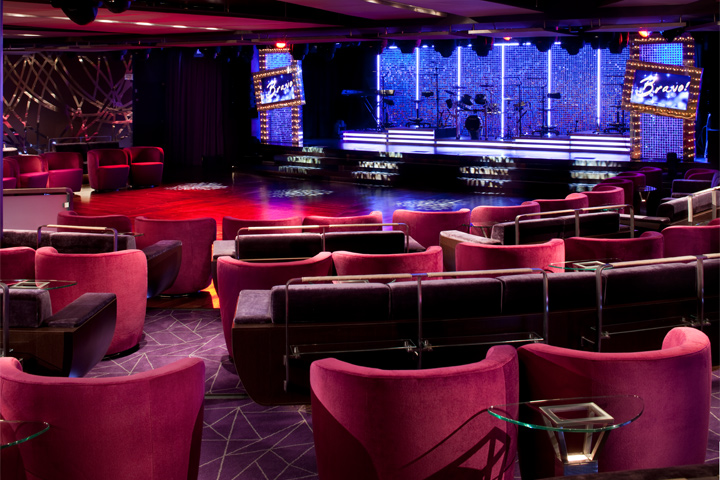
Onboard Activities

Activities & Services (included in cruise)

Show/Lounge

  • Art Gallery
  • Bars/Lounges
  • Business Center
  • Card Room
  • Casino
  • Concierge Desk
  • Conference Center
  • Disco/Nightclub
  • Duty-Free Shops/Boutiques
  • Educational Programs
  • Elevators
  • Fitness Center
  • Fitness Classes
  • Guest Lecturers
  • Infirmary/Medical Center
  • Internet Center
  • Library
  • Miniature Golf
  • Movies
  • Movies Under the Stars®
  • Pool - Indoor/Covered
  • Pool - Outdoor
  • Religious Services
  • Safe Deposit Boxes
  • Sauna/Steam Room
  • Self-Service Laundromat
  • Theaters/Show Lounge
  • Water Sports Platform
  • Wedding/Vow Renewal
  • Whirlpool/Jacuzzi

Activities & Services (available for an extra fee)

Spa

  • Beauty Salon
  • Dry Cleaning/Laundry Service
  • Full-Service Spa
  • Rock-Climbing Wall
  • Scuba Diving PADI
  • Spa Services/Massage
  • Sports Facilities
  • Surfing
  • Water Park
  • Water Slide

Costco Travel makes every effort to verify the accuracy of all information provided. Additional fees for amenities or services may be charged by the cruise line. Amenities or services may be discontinued or revised by the cruise line without notice. Staterooms designated as wheelchair-accessible do not necessarily meet ADA requirements. Costco Travel is not responsible for inaccuracies or provider modifications.

Dining

Main Dining

The Restaurant: Come when you like, with whom you please, and be seated as you wish. The room is beautiful, the cuisine is exquisite, and the service is simultaneously flawless, friendly and fun.
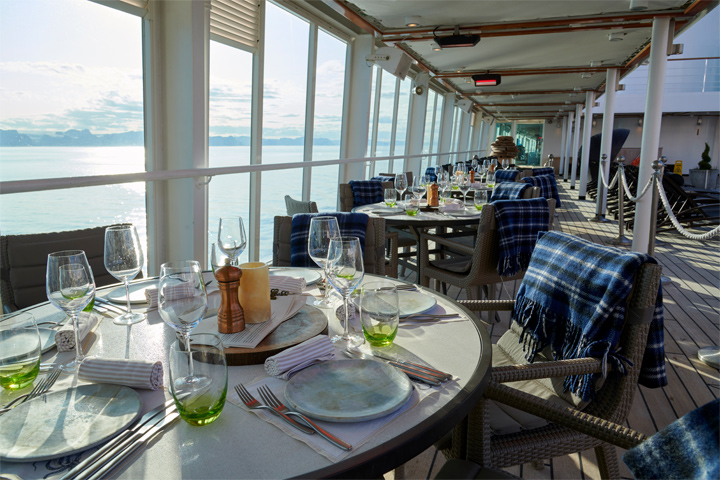
The Colonnade

Casual Dining

Coffee Bar: Enjoy a specialty crafted espresso just the way you like it.

Earth & Ocean: Each evening, the skilled chefs create an imaginative array of fresh, inventive dishes—a sophisticated menu celebrating eclectic traditional flavors from around the world, served in a relaxed setting under the stars for a distinctive dining experience unlike any other on board.

Observation Bar: A stunning round lounge with a square bar and panoramic views. Early Risers’ Coffee and Tea is served here every morning, and piano music makes it a great choice for drinks and conversation before and after dinner.

Seabourn Square: Whether you're looking for a place to enjoy your newspaper in the morning or want to socialize with your fellow passengers, Seabourn Square is what you're looking for. This inviting lounge offers plush seating, cocktail tables, a library, computer terminals, a coffee bar, and Guest Services staff.

Solis: Offering light, modern Mediterranean cuisine bursting with color and character, prepared fresh and entirely from scratch.​

The Club: Open for afternoon tea then transforms into a dance club in the evening. Socialize while enjoying cocktails, live music, and great company. Serving a variety of light sushi bites freshly made to order each evening.

The Colonnade: The more casual, indoor/outdoor alternative features an open kitchen, lavish buffets or table service for breakfasts and lunch, and serves regionally themed, bistro-style dinners with table service nightly.

The Patio: Relaxed poolside dining offering luncheon buffets, salads, soups, grilled specialties and freshly baked pizza. Dinners feature a full menu in an alfresco setting.

Sky Bar: A place to enjoy a refreshing tropical beverage during the day, or an evening cocktail under the stars.

In-Suite Dining: A varied menu available around the clock for service in your suite. You may also order dinner from The Restaurant menu and have your meal served, course by course, in your suite or on your veranda.


Times, costs and other specifics are outside the control of Costco Travel. All information is at the sole discretion of the cruise line and is subject to change without notice. Dining time and table size preferences are submitted to the cruise line on a first-come, first-served request basis and are confirmed aboard ship. Questions, concerns and/or special needs regarding dining arrangements must be addressed with the maitre d' hotel aboard ship. Every effort is made to accommodate travelers' preferences; however, Costco Travel cannot guarantee dining arrangements. In specialty restaurants, space is limited and reservations are recommended. A cover charge and dress code may apply.

Staterooms

All Ocean View Suites feature a large picture window, comfortable living area, queen-size bed or two twin beds, dining table for two, walk-in closet, interactive flat-screen television with music and movies, fully stocked bar and refrigerator, makeup vanity, spacious bathroom with separate tub and shower. Approximately 295 sq. ft. (28 sq.m.) of inside space.

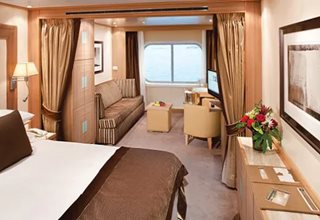
  • Ocean View Suite with Large Picture Window (Category: A)

    Category: A
    All Ocean View Suites feature a large picture window, comfortable living area, queen-size bed or two twin beds, dining table for two, walk-in closet, interactive flat-screen television with music and movies, fully stocked bar and refrigerator, makeup vanity, spacious bathroom with separate tub and shower. 

    Approximately 295 sq. ft. (28 sq.m.) of inside space.

  • Ocean View Suite with Large Picture Window (Category: A1)

    Category: A1
    All Ocean View Suites feature a large picture window, comfortable living area, queen-size bed or two twin beds, dining table for two, walk-in closet, interactive flat-screen television with music and movies, fully stocked bar and refrigerator, makeup vanity, spacious bathroom with separate tub and shower. 

    Approximately 295 sq. ft. (28 sq.m.) of inside space.

  • Interline Guarantee Rate - Suite (Category: RR)

    Category: RR
    This category can be booked for a special rate, guaranteed to you. Please note that the category is not associated at the time of booking with a specific stateroom, deck, bedding configuration or other particular settings. The assignment of an actual cabin will be performed during your check-in. The cabin can be anywhere on the ship.

  • Guarantee - Suite (Category: OS)

    Category: OS
    This category can be booked for a special rate, guaranteed to you. Please note that the category is not associated at the time of booking with a specific stateroom, deck, bedding configuration or other particular settings. The assignment of an actual cabin will be performed during your check-in. The cabin can be anywhere on the ship.

All Veranda Suites feature a full-length window and glass door to private veranda, comfortable living area, queen-size bed or two twin beds, dining table for two, walk-in closet, interactive flat-screen television with music and movies, fully stocked bar and refrigerator, makeup vanity, spacious bathroom with separate tub and shower.
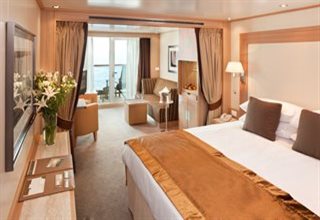
  • Veranda Suite (Category: V1)

    Category: V1
    All Veranda Suites feature a full-length window and glass door to private veranda, comfortable living area, queen-size bed or two twin beds, dining table for two, walk-in closet, interactive flat-screen television with music and movies, fully stocked bar and refrigerator, makeup vanity, spacious bathroom with separate tub and shower.

  • Veranda Suite (Category: V2)

    Category: V2
    All Veranda Suites feature a full-length window and glass door to private veranda, comfortable living area, queen-size bed or two twin beds, dining table for two, walk-in closet, interactive flat-screen television with music and movies, fully stocked bar and refrigerator, makeup vanity, spacious bathroom with separate tub and shower.

  • Veranda Suite (Category: V3)

    Category: V3
    All Veranda Suites feature a full-length window and glass door to private veranda, comfortable living area, queen-size bed or two twin beds, dining table for two, walk-in closet, interactive flat-screen television with music and movies, fully stocked bar and refrigerator, makeup vanity, spacious bathroom with separate tub and shower.

  • Veranda Suite (Category: V4)

    Category: V4
    All Veranda Suites feature a full-length window and glass door to private veranda, comfortable living area, queen-size bed or two twin beds, dining table for two, walk-in closet, interactive flat-screen television with music and movies, fully stocked bar and refrigerator, makeup vanity, spacious bathroom with separate tub and shower.

  • Interline Guarantee Rate - Balcony (Category: RB)

    Category: RB
    This category can be booked for a special rate, guaranteed to you. Please note that the category is not associated at the time of booking with a specific stateroom, deck, bedding configuration or other particular settings. The assignment of an actual cabin will be performed during your check-in. The cabin can be anywhere on the ship.

  • Guarantee - Suite (Category: SV)

    Category: SV
    This category can be booked for a special rate, guaranteed to you. Please note that the category is not associated at the time of booking with a specific stateroom, deck, bedding configuration or other particular settings. The assignment of an actual cabin will be performed during your check-in. The cabin can be anywhere on the ship.

All Penthouse Suites on board feature a comfortable living area, glass door to private veranda, queen-size bed or two twin beds; walk-in closet with personal safe, two flat-screen TV with music and movies, fully stocked bar and refrigerator, writing desk with personalized stationary, makeup vanity, spacious bathroom with separate tub and shower, plush robes, slippers hair dryer and 110/220V AC outlets.
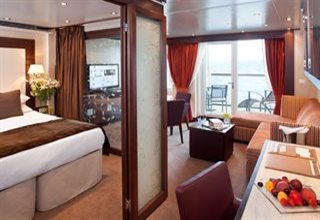
  • Penthouse Guarantee (Category: PG)

    Category: PG
    This category can be booked for a special rate, guaranteed to you. Please note that the category is not associated at the time of booking with a specific stateroom, deck, bedding configuration or other particular settings. The assignment of an actual cabin will be performed during your check-in. The cabin can be anywhere on the ship.

  • Penthouse Suite (Category: PH)

    Category: PH
    All Penthouse Suites on board feature a comfortable living area, glass door to private veranda, queen-size-bed or two twin beds; walk-in closet with personal safe, two flat-screen TV with music and movies, fully stocked bar and refrigerator, writing desk with personalized stationary, makeup vanity, spacious bathroom with separate tub and shower, plush robes, slippers, hair dryer, and 110/220V AC outlets.
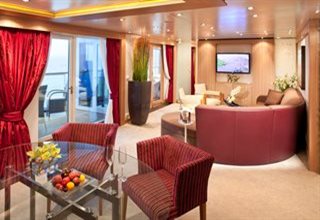
  • Grand Suite (Category: GR)

    Category: GR
    Suites on board feature a comfortable living area, private veranda, queen-size-bed or two twin beds; walk-in closet with personal safe, interactive flat-screen TV with music and movies, fully stocked bar and refrigerator, writing desk with personalized stationary, makeup vanity, spacious bathroom with separate tub and shower, plush robes, slippers, hair dryer, and 110/220V AC outlets.
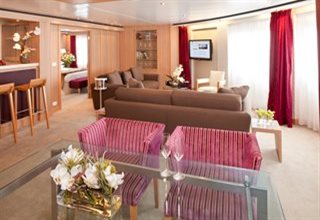
  • Signature Suite (Category: SS)

    Category: SS
    Suites on board feature a comfortable living area, private veranda, queen-size-bed or two twin beds; walk-in closet with personal safe, interactive flat-screen TV with music and movies, fully stocked bar and refrigerator, writing desk with personalized stationary, makeup vanity, spacious bathroom with separate tub and shower, plush robes, slippers, hair dryer, and 110/220V AC outlets.
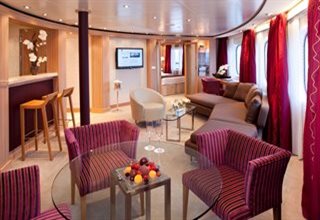
  • Wintergarden Suite (Category: WG)

    Category: WG
    Suites on board feature a comfortable living area, private veranda, queen-size-bed or two twin beds; walk-in closet with personal safe, interactive flat-screen TV with music and movies, fully stocked bar and refrigerator, writing desk with personalized stationary, makeup vanity, spacious bathroom with separate tub and shower, plush robes, slippers, hair dryer, and 110/220V AC outlets.

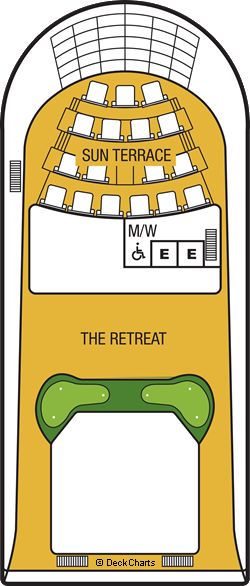
  • Owner's Suite (Category: O1)

    Category: O1
    Suites on board feature a comfortable living area, private veranda, queen-size-bed or two twin beds; walk-in closet with personal safe, interactive flat-screen TV with music and movies, fully stocked bar and refrigerator, writing desk with personalized stationary, makeup vanity, spacious bathroom with separate tub and shower, plush robes, slippers, hair dryer, and 110/220V AC outlets.

  • Owner's Suite (Category: O2)

    Category: O2
    Suites on board feature a comfortable living area, private veranda, queen-size-bed or two twin beds; walk-in closet with personal safe, interactive flat-screen TV with music and movies, fully stocked bar and refrigerator, writing desk with personalized stationary, makeup vanity, spacious bathroom with separate tub and shower, plush robes, slippers, hair dryer, and 110/220V AC outlets.

  • Penthouse Spa Suite (Category: PS)

    Category: PS
    All Penthouse Suites on board feature a comfortable living area, glass door to private veranda, queen-size-bed or two twin beds; walk-in closet with personal safe, two flat-screen TV with music and movies, fully stocked bar and refrigerator, writing desk with personalized stationary, makeup vanity, spacious bathroom with separate tub and shower, plush robes, slippers, hair dryer, and 110/220V AC outlets.

Deck Plan

Cruise Ship
Deck 11
Key to Symbols
SymbolDescription
Wheelchair-accessible suite; roll-in shower only; wheelchair-accessible doorways; Suite 635 also has a tubWheelchair-accessible suite; roll-in shower only; wheelchair-accessible doorways; Suite 635 also has a tub
Veranda railings are part metal and part glass from floor to teak railVeranda railings are part metal and part glass from floor to teak rail
Subject to noise when anchoring; has all-metal veranda railings, limiting the viewSubject to noise when anchoring; has all-metal veranda railings, limiting the view
Smaller verandaSmaller veranda
Third guest capacity suiteThird guest capacity suite
ElevatorElevator
Self service launderetteSelf service launderette
Suite can be reached only via a staircaseSuite can be reached only via a staircase
Partially obstructed veranda viewPartially obstructed veranda view

Ship Facts

Seabourn Quest ship image
  • Ship Name: Seabourn Quest
  • Ship Name: Seabourn Quest
  • Year Built: 2010
  • Year Entered Present Fleet: 2011
  • Ship Class: O
  • Maximum Capacity: 458
  • Number of Passenger Decks: 9
  • Number of Crew: 295
  • Officers' Nationality: International
  • Tonnage (GRT): 32,000
  • Capacity Based on Double Occupancy: 458
  • Country of Registry: The Bahamas
  • Total Staterooms: 229
  • Crew/Hotel Staff Nationality: International
Costco Travel makes every effort to verify the accuracy of all information provided. Additional fees for amenities or services may be charged by the hotel, resort or cruise line. Amenities or services may be discontinued or revised by the provider without notice. Hotels, resorts, ships or accommodations designated as wheelchair-accessible do not necessarily meet ADA requirements. Costco Travel is not responsible for inaccuracies or provider modifications.

Costco Member Reviews

Available Dates and Prices

Departure Date

Inside Stateroom

Ocean View Stateroom

Balcony Stateroom

Suite Stateroom

Departure Date - 01/07/2028

Inside Stateroom

N/A

Ocean View Stateroom

$77,999

Balcony Stateroom

$88,999

Suite Stateroom

N/A

Terms & Conditions

*Price shown is per person based on double occupancy, is valid for select stateroom categories only and does include government taxes/fees and gratuities. Click on the Terms & Conditions link below for details.

**Select complimentary shore excursions are for full-fare guests only, capacity controlled and subject to availability. Shore excursion reservations are accepted on a first-come, first-served basis. Please note, available excursions vary by sailing date and day of the week. Government fees and taxes are included. Requested excursions may not be available at time of booking. Supplement will apply on Ventures by Seabourn®, optional shore excursions. Restrictions apply and penalties apply 36 hours prior to shore excursion start date.

†One Digital Costco Shop Card per room/stateroom, per stay. The exact amount of the Digital Costco Shop Card will be calculated during the booking process. The Digital Costco Shop Card promotion is nontransferable and may not be combined with any other promotion. A Digital Costco Shop Card will arrive by email approximately 10 days after the start of your cruise. Click on the Terms & Conditions link below for additional information.

Ship's registry: The Bahamas

    Package ID: SBNQUEWOR20280107

    Digital Costco Shop Card

    Book this cruise with Costco Travel and receive a Digital Costco Shop Card. The Digital Costco Shop Card is a convenient payment option in our warehouses and on Costco.com.



    Screen is Loading
    Screen is Loading
    We are processing your payment. Do not refresh your browser or exit this page.