 Help Center

 United States
 Canada
 Australia
Coupon Override
Please Call
For drivers under the age of 25, additional fees and/or restrictions may apply.
For information and assistance in completing your reservation, please call:
1-866-921-7925Sorry
We're unable to find your location.

South America: Amazon Explorer: Rivers & Rainforests
All-Inclusive Cruise:

All onboard gratuities
Unlimited beverages, including fine wines and premium spirits served throughout the ship
Complimentary dining venues
Complimentary in-suite bar
Complimentary caviar
Complimentary Wi-Fi packages with unlimited minutes
Welcome bottle of Champagne

Executive Member Benefit
Executive Members receive an annual 2% Reward, up to $1,250, on qualified Costco Travel purchases

Digital Costco Shop Card
Member Exclusive: Digital Costco Shop Card with every Seabourn® sailing†
Sailing Itinerary

Note: Cruise itineraries are subject to change. Please verify ports and times directly with the cruise line.

Overview


The City of Miami known as the “Magic City” is located in Southeast Florida, in Miami-Dade County on the Miami River, between the Florida Everglades and the Atlantic Ocean. Since its incorporation in 1896, the City has grown tremendously, transforming it into one of the world’s renowned centers where people can work, live, and play while enjoying a high quality of life. The City of Miami, known for its diverse culture and ethnicities is the largest municipality in Miami-Dade County. According to the 2000 census, it has a population of 362,470. By the year 2010, the population in the City is projected to rise to 390,191. Miami which is known as the Gateway to Latin America attracts a tremendous amount of foreign-born people, resulting in a large Latin American population that includes Cubans, Nicaraguans, Colombians, Venezuelans, Puerto Ricans, Argentineans, Ecuadorians, Brazilians, Dominicans, Haitians and Mexicans. According to the 2000 U.S. census, the City has a 60 percent Hispanic population, a 22.3 percent African-American population, and an 11.9 percent White/other population.
Overview
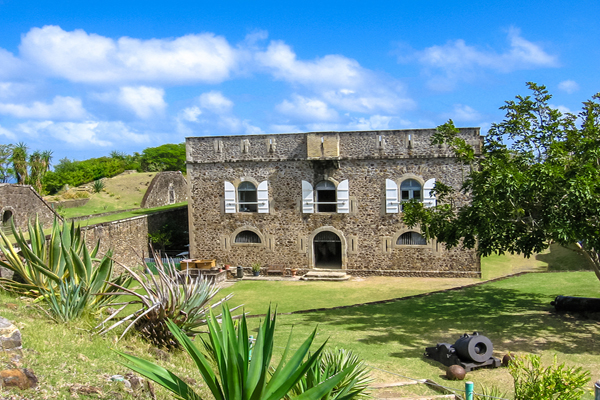
Basse-Terre is Guadeloupe's capital on the western 'wing' and more scenic of the country's main butterfly-shaped island. After crossing a bridge over a river, visitors can head north or south along the coasts or straight into the national park, an ecological spread covering one-fifth of Guadeloupe's total terrain. The park has a lush rainforest, a sparkling waterfall and pond, and a zoo and botanical garden. It also features a rum museum and a working sugar factory. There are miles of white-sand beaches, and offshore Pigeon Island is suitable for diving. From Basse-Terre, there are great views of La Soufriere, a dormant volcano located seven miles away. Motorcoaches take visitors almost to the summit (4,813 feet) to see the wisps of sulfur vapor and fumaroles. For other active clients, Guadeloupe offers practically every sport imaginable, including golf, tennis, squash, biking, hiking horseback riding, scuba diving, sailing, snorkeling, windsurfing, deep-sea fishing, water skiing, yachting, and plenty of spectator sports. Those who love to party will find nightclubs and discos in most of the large hotels and the island's casinos. The restaurants (Guadeloupe is touted as one of the culinary capitals of the Caribbean) are magnificent!
Overview
The center point of Bequia is the town of Port Elizabeth, a favorite stop of yachtsmen for supplies, repairs, or just plain fun. It wraps around Admiralty Bay and has a waterside sidewalk, called the Belmont Walkway which connects the cute jumble of shops, restaurants, bars, and small hotels lining the shoreline. You will have fun browsing the stores, stopping for refreshing drinks, and enjoying the marine activity – a constanthubbubb of boats of every sort and kind coming and going. A favorite "hang-out" is the Frangipani bar and restaurant.
Overview

Saint George's or Saint George, town (1991 pop. 4,439), capital of Grenada, in the West Indies. A port town on a deep and beautiful harbor, it is the administrative headquarters of the country and a growing tourist center. Chief exports are cacao, nutmeg, and mace. St. George's was the capital of the former British colony of the Windward Islands.
Overview

Port of Spain is still one of the most active commercial cities in the Caribbean. The cultural scene is as vital as ever, especially during the country's riotous Carnival -- a period of festivities, concerts, and shows that begins after Christmas and culminates in a two-day street parade that ends on Ash Wednesday. The capital is home to around 300,000 of Trinidad's 1.3 million residents -- Africans, Indians, Americans, Europeans, and Asians, each culture with its language and customs. About a quarter of the population is Hindu, which is why there's an abundance of East Indian festivals, religious celebrations, and delicious East Indian food.
Overview

The Amazon River and Flooded Forests ecoregion contains an extremely high number of freshwater animal species, including two species of freshwater dolphins. The ecoregion is characterized by extensive forested areas that become flooded during each rainy season. These "flooded forests" in the Amazon region are the most extensive of this habitat type in the entire world. The cycle of flooding, and the annual regeneration that it produces, represent a globally outstanding ecological phenomenon. The entire Amazon basin contains the largest number of freshwater fish species in the world, estimated at more than 3,000 species. Every year the Amazon River rises more than 30 feet (9 m) and floods surrounding forests. These rising waters replenish nutrients in floodplain areas and regenerate floodplain lakes, floating meadows, and other seasonal habitats. Freshwater fish move into these flooded forests and often feed on the fruits that drop from the trees. The Amazon is the second longest river in the world (after the Nile), stretching 4,000 miles (6,400 kilometers). But it's the largest when it comes to volume. The Amazon contains 20 percent of the Earth's freshwater, which it carries from high up in the Andes Mountains to the Atlantic Ocean. Along the way, it picks up rich soil that flows into dozens of streams and small rivers. The Amazon Basin has two freshwater systems, the igapó (blackwater) and the varzea (whitewater). The area contains a large number of minerals that fertilize land and help trees and other vegetation grow.
Overview

MACAPA, on the north bank of the Amazon and right on the equator, is the gateway to the state of Amapá and home to three-quarters of its population. Surrounded by uninhabited forests and hills, it dominates the northern section of the Amazon estuary. If you're coming by ferry from Belém you'll arrive to the southwest at Porto do Santana, just twenty minutes by bus or an hour by boat from Macapa, though it lies on the other side of the equator. The airport is 4km from town on Rua Hildemar Maia (tel 096/223-2323). The Rodoviaria faces the Policia Tecnica, 5km outside town on the BR-156; from there, local buses run to Praça Veiga Cabral in the ccenter The countryside around Macapá is, like the Ilha do Marajó in the estuary, roamed by large herds of water buffalo. In town, there is not a great deal to do. The highlight is the Fortaleza de São José (daily8 am6 pmpm), one of the largest colonial forts in Brazibuilt-in in 1764 out of material brought over as ballast in Portuguese ships, in response to worries that the French had designs on the north bank of the Amazon. It is often closed, but nobody will mind if you slip through the enormous main gates for a stroll along the battlements. There's an interesting daily artisan market nearby on Canal da Fortaleza, and you could spend some more time checking out the eighteenth-century Igreja São José de Macapá on the Praça Veiga Cabral and the Museu Histórico at Av. Mario Cruz 17 (Tues-Sun 8 am-noon & 6 pmpm). There's also a small private museum, the Instituto de Estudos e Pesquisas de Plantmedicinaisais (IEPA) at Av. Feliciano Coelho 1509, holding the Valdemiro Gomes collection of minerals, Amazon woods, and medicinal plants.
Overview
The Amazon River and Flooded Forests ecoregion contains an extremely high number of freshwater animal species, including two species of freshwater dolphins. The ecoregion is characterized by extensive forested areas that become flooded during each rainy season. These "flooded forests" in the Amazon region are the most extensive of this habitat type in the entire world. The cycle of flooding, and the annual regeneration that it produces, represent a globally outstanding ecological phenomenon. The entire Amazon basin contains the largest number of freshwater fish species in the world, estimated at more than 3,000 species. Every year the Amazon River rises more than 30 feet (9 m) and floods surrounding forests. These rising waters replenish nutrients in floodplain areas and regenerate floodplain lakes, floating meadows, and other seasonal habitats. Freshwater fish move into these flooded forests and often feed on the fruits that drop from the trees. The Amazon is the second longest river in the world (after the Nile), stretching 4,000 miles (6,400 kilometers). But it's the largest when it comes to volume. The Amazon contains 20 percent of the Earth's freshwater, which it carries from high up in the Andes Mountains to the Atlantic Ocean. Along the way, it picks up rich soil that flows into dozens of streams and small rivers. The Amazon Basin has two freshwater systems, the igapó (blackwater) and the varzea (whitewater). The area contains a large number of minerals that fertilize land and help trees and other vegetation grow.
Overview

The city of Santarem is located between two great rivers, the Amazon and the Tapajos. It is there that the meeting of the green-emerald waters of the Tapajós with the brown waters of the Amazon occurs. From the moment they meet the rivers run together for a good time without mixing. 710 kilometers from Belém, Santarém offers a variety of tourist attractions. The access is easy. There the tourist can enjoy the beauty of the Alter-do-Chão beach, bathed by the crystal clear waters of the Tapajós. Fishing is one of the most popular attractions of Santarem, especially fishing the tucunare.
Overview
Boca de Valeria is the entrance to the Valeria Channel (boca meaning mouth). The channel leads to Lake Valeria, which marks the border between the States of Amazonas and Pará.
Overview

Parintins stands out as the most hospitable cultural city in the region. The island where it today stands Parintins was reached by Portuguese Captain J. Pedro Cordovil in 1796. Its people exhibit an artistic expression recognized worldwide due to their folkloric festival. The city has a population of 71.574, in an area of 7,069 square Km, and is located on the right bank of the Amazon River on the Island of Tupinambarana. The hot and humid climate, with an average temp. of 35ºC and 85% humidity, explains the mystery of the city destined for success. The area´s relief consists of forests of floodplains and highlands, lakes, islands, and a small mountain ridge that forms the border between the states of Amazonas and Pará. Parintins distinguishes itself from other cities because everything the city breathes culture, magic, beauty, and happiness year-round.
Overview

MANAUS is the capital of Amazonas, a tropical forest state covering around one and a half million square kilometres. It is also the commercial and physical hub of the entire Amazon region. Most visitors are surprised to learn that Manaus isn’t actually on the Amazon at all. Rather it lies on the Rio Negro, six kilometres from the point where that river meets the Solimões to form (as far as Brazilians are concerned) the Rio Amazonas. Just a few hundred metres away from the tranquil life on the rivers, the centre of Manaus perpetually buzzes with energy: always noisy, crowded and confused. Escaping from the frenzy is not easy, but there is the occasional quiet corner, and the sights of the port, markets, Opera House and some of the museums make up for the hectic pace in the downtown area. In the port and market areas, where the infamous Porto do Manaus smell is inescapable, pigs and chickens line the streets and there’s an atmosphere which seems unchanged in centuries. For the Amazon hinterland, Manaus has long symbolized “civilization”. Traditionally, this meant simply that it was the trading centre, where the hardships of life in the forest could be escaped temporarily and where manufactured commodities to make that life easier could be purchased – metal pots, steel knives, machetes and the like. Virgin jungle seems further from the city these days – just how far really depends on what you want “virgin forest” to mean – but there are still waterways and channels within a short river journey of Manaus where you can find dolphins, alligators, kingfishers and the impression, at least, that man has barely penetrated. Indeed, most visitors to Manaus rightly regard a river trip as an essential part of their stay; there is a variety of jungle tour and lodge options. Even if you can’t afford the time to disappear up the Amazon for days at a stretch, however, there are a number of sites around Manaus that make worthwhile day excursions, most notably the meeting of the waters of the yellow Rio Solimões and the black Rio Negro, and the lily-strewn Parque Ecólogico Janauary. History The name Manaus came originally from the Manau tribe which was encountered in this region by São Luís do Maranhão, exploring the area in 1616. He called the spot São Luís del Rio. But it was Francisco do Motta Falco who really founded Manaus by building up the settlement and encouraging others to remain there with him. The city you see today is primarily a product of the rubber boom and in particular the child of visionary state governor Eduardo Ribeiro, who from 1892 transformed Manaus into a major city. Under Ribeiro the Opera House was completed, and whole streets were wiped out in the process of laying down broad Parisian-style avenues, interspersed with Italian piazzas centred on splendid fountains. In 1899 Manaus was the first Brazilian city to have trolley buses and only the second to have electric lights in the streets. Around the turn of the nineteenth century Manaus was an opulent metropolis run by elegant people, who dressed and housed themselves as fashionably as their counterparts in any large European city. The rich constructed palaces and grandiose mansions; time was passed at elaborate entertainments, dances and concerts. But this heyday lasted barely thirty years, and by 1914 the rubber market was collapsing fast; Ribeiro himself had committed suicide in 1900. There was a second brief boost for Brazilian rubber during World War II, but today’s prosperity is largely due to the creation of a Free Trade Zone, the Zona Franca, in 1966. Over the following ten years the population doubled, from 250,000 to half a million, and many new industries moved in, especially electronics companies. An impressive new international airport was opened in 1976 and the floating port, supported on huge metal cylinders to cope with variations of as much as 14m in the level of the river, was modernized to cope with the new business. Today, with over three million inhabitants, Manaus is an aggressive commercial and industrial centre for an enormous region the Hong Kong of the Amazon. Over half of Brazil’s televisions are made here and electronic goods are around a third cheaper here than in the south. All of this helps encourage domestic tourism – Manaus airport is crowded with Brazilians going home with their arms laden with TVs, hi-fis, computers and fax machines. The City It’s not hard to get used to the layout of the city, and most things of interest huddle close to the water. From the floating port where the big ships dock, riverboat wharves extend round past the market, from one end of Rua dos Andradas to the other. The busiest commercial streets are immediately behind, extending up to the Avenida Sete de Setembro, with the cathedral marking one end of the downtown district, the Praça da Polícia the other. Beyond Avenida Sete de Setembro, towards the Opera House, it’s a bit calmer, with more offices and fewer shops. The busy Praça da Matriz by the cathedral is the main hub of city communications, with buses to local points around the city and suburbs; another good connection point for city buses and taxis is the east side of Avenida Getúlio Vargas just north of Avenida Sete de Setembro.
Overview
Boca de Valeria is the entrance to the Valeria Channel (boca meaning mouth). The channel leads to Lake Valeria, which marks the border between the States of Amazonas and Pará.
Overview

Alter-do-Chao village is 30 km from Santarem. It is the most sought-after village in the region and a popular stop on the route of foreign cruises. Bathed by the Tapajos River, its beaches are temporary, depending on the tides of the river. One of the curiosities of the place is the green lake, whose waters change during the day, from blue to green. Annually, in September, the Party of the Caire happens, a folkloric and religious manifestation that lasts 8 days. They several presentations of dance and music of quaint names: camelu, desfeiteira, lundu, the waltz of tip of the handkerchief, marambire, quadrilha, cruisador tupi, macucaua, cecuiara and many others.
Overview
The Amazon River and Flooded Forests ecoregion contains an extremely high number of freshwater animal species, including two species of freshwater dolphins. The ecoregion is characterized by extensive forested areas that become flooded during each rainy season. These "flooded forests" in the Amazon region are the most extensive of this habitat type in the entire world. The cycle of flooding, and the annual regeneration that it produces, represent a globally outstanding ecological phenomenon. The entire Amazon basin contains the largest number of freshwater fish species in the world, estimated at more than 3,000 species. Every year the Amazon River rises more than 30 feet (9 m) and floods surrounding forests. These rising waters replenish nutrients in floodplain areas and regenerate floodplain lakes, floating meadows, and other seasonal habitats. Freshwater fish move into these flooded forests and often feed on the fruits that drop from the trees. The Amazon is the second longest river in the world (after the Nile), stretching 4,000 miles (6,400 kilometers). But it's the largest when it comes to volume. The Amazon contains 20 percent of the Earth's freshwater, which it carries from high up in the Andes Mountains to the Atlantic Ocean. Along the way, it picks up rich soil that flows into dozens of streams and small rivers. The Amazon Basin has two freshwater systems, the igapó (blackwater) and the varzea (whitewater). The area contains a large number of minerals that fertilize land and help trees and other vegetation grow.
Overview

Ile du Diable, Devil's Island, off the coast of French Guiana, is one of the three Iles du Salut (Islands of Salvation or Health), so named because they provided a more healthy environment than the mainland for the French gold seekers of the 1760s. The other two are Ile St. Joseph and Ile Royale, separated from Devil's Island by a vicious tide. In later years, Ile du Diable became part of the prison system developed in French Guiana. Other locations were on the mainland, and the other two islands, but over time, the entire penal colony was called Devil's Island.
Overview

Castries is the capital and largest city of Saint Lucia, an island country in the Caribbean. The quarter with the same name had a population of 70,000 on 22 May 2013 and stretches over an area of 80 km2. Castries is in a flood gut and is built on reclaimed land. It houses the seat of government and the head offices of many foreign and local businesses. The city's design is in a grid pattern. Its sheltered harbor receives cargo vessels, ferry boats, and cruise ships. It houses duty-free shopping facilities such as Point Seraphine and La Place Carenage. Many restaurants offer menus from local to Chinese. Supermarkets and other shopping facilities provide goods. The city is well served by a bus system and taxi service.
Overview

There was never any hope of lucrative sugar plantations in St.Barths. It was too dry, too steep, too rocky, and, finally, too small. Unsuitable for agriculture, the island was never coveted as a prize during the colonial wars of the 18th century. The place did, however, have a serviceable harbor, and this allowed the town that grew around it, Gustavia, to play a key role in that intermittent conflict, a role that was to presage much of its future. As a free port under Swedish rule, Gustavia served the useful purpose of providing a trade and supply center for the various warring factions. When a sea captain captured a prize or raided a settlement, he could sell the booty in St. Barths, and at the same time resupply his ship. Overflowing warehouses surrounded a harbor packed with ships from many nations and a mercantile and architectural tradition was established that has lingered to the present day. Today, the town has adjusted itself to satisfy the increasing number of visiting tourists. Restaurants, boutiques, and gift shops now line streets once busy with merchants, merchant seamen, and adventurers.
Overview

Cruz Bay, St. John ... here's where the ferry coming from St. Thomas drops you off. There are taxis and car rentals all within walking distance. Within Cruz Bay, you will find a US Post Office, two banks, the Elaine Sprauve Library & Museum, and the new National Park Visitor Center. If you are hungry or thirsty when you arrive, there is a large assortment of restaurants and bars to choose from. And don't forget to pick up an island souvenir from one of the many colorful local gift shops and boutiques!
Overview
The City of Miami known as the “Magic City” is located in Southeast Florida, in Miami-Dade County on the Miami River, between the Florida Everglades and the Atlantic Ocean. Since its incorporation in 1896, the City has grown tremendously, transforming it into one of the world’s renowned centers where people can work, live, and play while enjoying a high quality of life. The City of Miami, known for its diverse culture and ethnicities is the largest municipality in Miami-Dade County. According to the 2000 census, it has a population of 362,470. By the year 2010, the population in the City is projected to rise to 390,191. Miami which is known as the Gateway to Latin America attracts a tremendous amount of foreign-born people, resulting in a large Latin American population that includes Cubans, Nicaraguans, Colombians, Venezuelans, Puerto Ricans, Argentineans, Ecuadorians, Brazilians, Dominicans, Haitians and Mexicans. According to the 2000 U.S. census, the City has a 60 percent Hispanic population, a 22.3 percent African-American population, and an 11.9 percent White/other population.
Onboard the Seabourn Quest
Seabourn Quest
Costco Member Reviews

Year Built: 2010
Double Occupancy Capacity: 458
Seabourn Quest, an oceangoing ship with a passenger capacity of just 458 guests, offers spacious accommodations spanning categories ranging in size from 295 to 1,182 square feet of indoor space. Verandas add an additional 65 to 558 square feet of outdoor living area spacious enough for private al fresco dining. All suites feature a comfortable living area, walk-in closet, fully stocked bar and refrigerator filled with seaside favorites. Expansive ocean views are framed by either a picture window or the glass doors of the veranda.
Onboard Activities
Activities & Services (included in cruise)
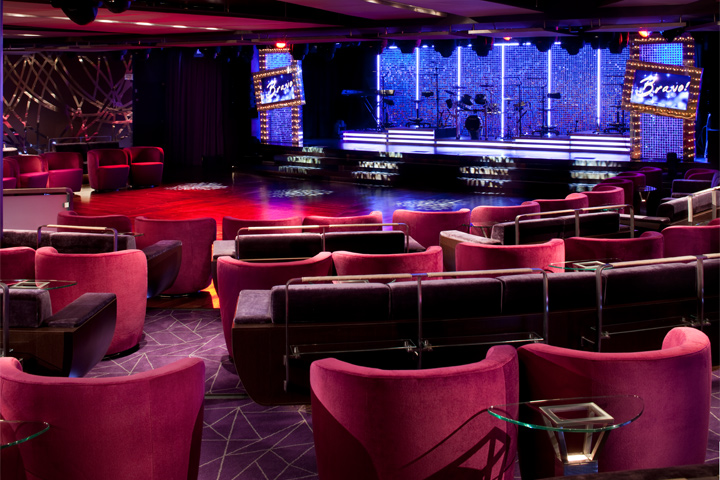
Show/Lounge
- Art Gallery
- Bars/Lounges
- Business Center
- Card Room
- Casino
- Concierge Desk
- Conference Center
- Disco/Nightclub
- Duty-Free Shops/Boutiques
- Educational Programs
- Elevators
- Fitness Center
- Fitness Classes
- Guest Lecturers
- Infirmary/Medical Center
- Internet Center
- Library
- Miniature Golf
- Movies
- Movies Under the Stars®
- Pool - Indoor/Covered
- Pool - Outdoor
- Religious Services
- Safe Deposit Boxes
- Sauna/Steam Room
- Self-Service Laundromat
- Theaters/Show Lounge
- Water Sports Platform
- Wedding/Vow Renewal
- Whirlpool/Jacuzzi
Activities & Services (available for an extra fee)
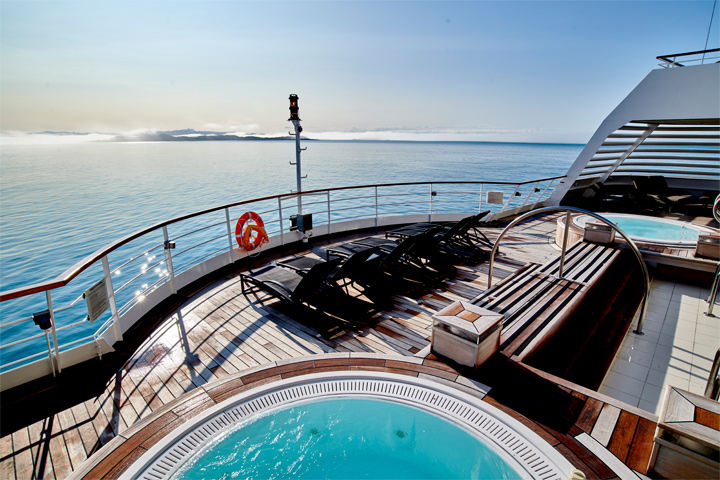
Spa
- Beauty Salon
- Dry Cleaning/Laundry Service
- Full-Service Spa
- Rock-Climbing Wall
- Scuba Diving PADI
- Spa Services/Massage
- Sports Facilities
- Surfing
- Water Park
- Water Slide
Dining
Main Dining
The Restaurant: Come when you like, with whom you please, and be seated as you wish. The room is beautiful, the cuisine is exquisite, and the service is simultaneously flawless, friendly and fun.
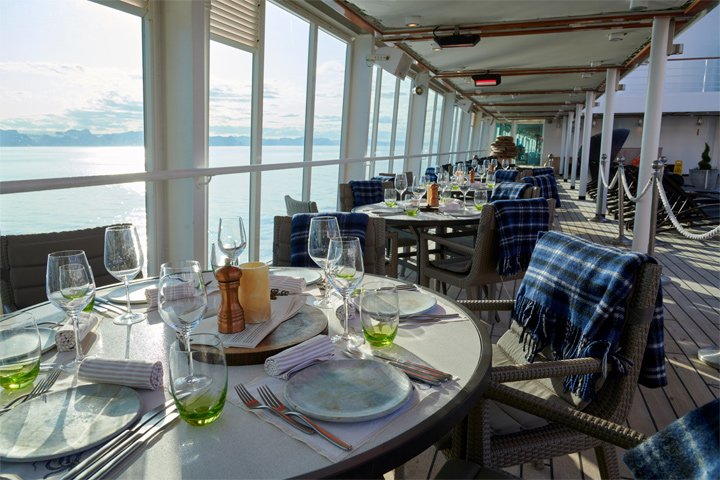
The Colonnade
Casual Dining
Coffee Bar: Enjoy a specialty crafted espresso just the way you like it.
Earth & Ocean: Each evening, the skilled chefs create an imaginative array of fresh, inventive dishes—a sophisticated menu celebrating eclectic traditional flavors from around the world, served in a relaxed setting under the stars for a distinctive dining experience unlike any other on board.
Observation Bar: A stunning round lounge with a square bar and panoramic views. Early Risers’ Coffee and Tea is served here every morning, and piano music makes it a great choice for drinks and conversation before and after dinner.
Seabourn Square: Whether you're looking for a place to enjoy your newspaper in the morning or want to socialize with your fellow passengers, Seabourn Square is what you're looking for. This inviting lounge offers plush seating, cocktail tables, a library, computer terminals, a coffee bar, and Guest Services staff.
Solis: Offering light, modern Mediterranean cuisine bursting with color and character, prepared fresh and entirely from scratch.
The Club: Open for afternoon tea then transforms into a dance club in the evening. Socialize while enjoying cocktails, live music, and great company. Serving a variety of light sushi bites freshly made to order each evening.
The Colonnade: The more casual, indoor/outdoor alternative features an open kitchen, lavish buffets or table service for breakfasts and lunch, and serves regionally themed, bistro-style dinners with table service nightly.
The Patio: Relaxed poolside dining offering luncheon buffets, salads, soups, grilled specialties and freshly baked pizza. Dinners feature a full menu in an alfresco setting.
Sky Bar: A place to enjoy a refreshing tropical beverage during the day, or an evening cocktail under the stars.
In-Suite Dining: A varied menu available around the clock for service in your suite. You may also order dinner from The Restaurant menu and have your meal served, course by course, in your suite or on your veranda.
Staterooms
All Ocean View Suites feature a large picture window, comfortable living area, queen-size bed or two twin beds, dining table for two, walk-in closet, interactive flat-screen television with music and movies, fully stocked bar and refrigerator, makeup vanity, spacious bathroom with separate tub and shower. Approximately 295 sq. ft. (28 sq.m.) of inside space.
- Ocean View Suite with Large Picture Window (Category: A)

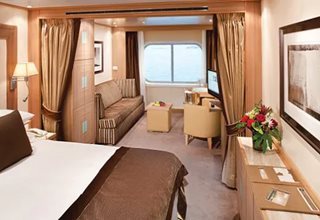
Category: A
All Ocean View Suites feature a large picture window, comfortable living area, queen-size bed or two twin beds, dining table for two, walk-in closet, interactive flat-screen television with music and movies, fully stocked bar and refrigerator, makeup vanity, spacious bathroom with separate tub and shower.
Approximately 295 sq. ft. (28 sq.m.) of inside space.
- Ocean View Suite with Large Picture Window (Category: A1)
Category: A1
All Ocean View Suites feature a large picture window, comfortable living area, queen-size bed or two twin beds, dining table for two, walk-in closet, interactive flat-screen television with music and movies, fully stocked bar and refrigerator, makeup vanity, spacious bathroom with separate tub and shower.
Approximately 295 sq. ft. (28 sq.m.) of inside space.
- Guarantee - Suite (Category: OS)
Category: OS
This category can be booked for a special rate, guaranteed to you. Please note that the category is not associated at the time of booking with a specific stateroom, deck, bedding configuration or other particular settings. The assignment of an actual cabin will be performed during your check-in. The cabin can be anywhere on the ship.
All Veranda Suites feature a full-length window and glass door to private veranda, comfortable living area, queen-size bed or two twin beds, dining table for two, walk-in closet, interactive flat-screen television with music and movies, fully stocked bar and refrigerator, makeup vanity, spacious bathroom with separate tub and shower.
- Veranda Suite (Category: V1)
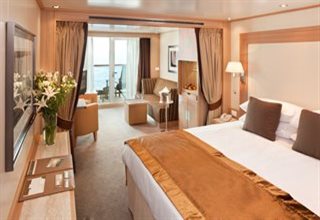
Category: V1
All Veranda Suites feature a full-length window and glass door to private veranda, comfortable living area, queen-size bed or two twin beds, dining table for two, walk-in closet, interactive flat-screen television with music and movies, fully stocked bar and refrigerator, makeup vanity, spacious bathroom with separate tub and shower.
- Veranda Suite (Category: V2)
Category: V2
All Veranda Suites feature a full-length window and glass door to private veranda, comfortable living area, queen-size bed or two twin beds, dining table for two, walk-in closet, interactive flat-screen television with music and movies, fully stocked bar and refrigerator, makeup vanity, spacious bathroom with separate tub and shower.
- Veranda Suite (Category: V3)
Category: V3
All Veranda Suites feature a full-length window and glass door to private veranda, comfortable living area, queen-size bed or two twin beds, dining table for two, walk-in closet, interactive flat-screen television with music and movies, fully stocked bar and refrigerator, makeup vanity, spacious bathroom with separate tub and shower.
- Veranda Suite (Category: V4)
Category: V4
All Veranda Suites feature a full-length window and glass door to private veranda, comfortable living area, queen-size bed or two twin beds, dining table for two, walk-in closet, interactive flat-screen television with music and movies, fully stocked bar and refrigerator, makeup vanity, spacious bathroom with separate tub and shower.
- Guarantee - Suite (Category: SV)
Category: SV
This category can be booked for a special rate, guaranteed to you. Please note that the category is not associated at the time of booking with a specific stateroom, deck, bedding configuration or other particular settings. The assignment of an actual cabin will be performed during your check-in. The cabin can be anywhere on the ship.
All Penthouse Suites on board feature a comfortable living area, glass door to private veranda, queen-size bed or two twin beds; walk-in closet with personal safe, two flat-screen TV with music and movies, fully stocked bar and refrigerator, writing desk with personalized stationary, makeup vanity, spacious bathroom with separate tub and shower, plush robes, slippers hair dryer and 110/220V AC outlets.
- Penthouse Guarantee (Category: PG)
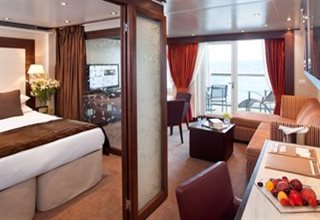
Category: PG
This category can be booked for a special rate, guaranteed to you. Please note that the category is not associated at the time of booking with a specific stateroom, deck, bedding configuration or other particular settings. The assignment of an actual cabin will be performed during your check-in. The cabin can be anywhere on the ship.
- Penthouse Suite (Category: PH)
Category: PH
All Penthouse Suites on board feature a comfortable living area, glass door to private veranda, queen-size-bed or two twin beds; walk-in closet with personal safe, two flat-screen TV with music and movies, fully stocked bar and refrigerator, writing desk with personalized stationary, makeup vanity, spacious bathroom with separate tub and shower, plush robes, slippers, hair dryer, and 110/220V AC outlets.
- Grand Suite (Category: GR)
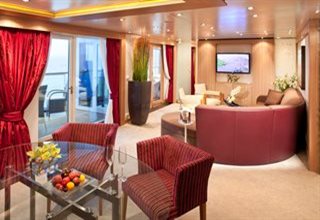
Category: GR
Suites on board feature a comfortable living area, private veranda, queen-size-bed or two twin beds; walk-in closet with personal safe, interactive flat-screen TV with music and movies, fully stocked bar and refrigerator, writing desk with personalized stationary, makeup vanity, spacious bathroom with separate tub and shower, plush robes, slippers, hair dryer, and 110/220V AC outlets.
- Signature Suite (Category: SS)
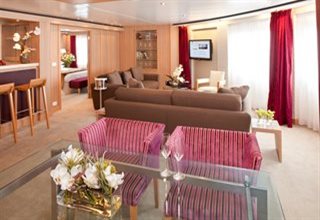
Category: SS
Suites on board feature a comfortable living area, private veranda, queen-size-bed or two twin beds; walk-in closet with personal safe, interactive flat-screen TV with music and movies, fully stocked bar and refrigerator, writing desk with personalized stationary, makeup vanity, spacious bathroom with separate tub and shower, plush robes, slippers, hair dryer, and 110/220V AC outlets.
- Wintergarden Suite (Category: WG)
Category: WG
Suites on board feature a comfortable living area, private veranda, queen-size-bed or two twin beds; walk-in closet with personal safe, interactive flat-screen TV with music and movies, fully stocked bar and refrigerator, writing desk with personalized stationary, makeup vanity, spacious bathroom with separate tub and shower, plush robes, slippers, hair dryer, and 110/220V AC outlets.
- Owner's Suite (Category: O1)
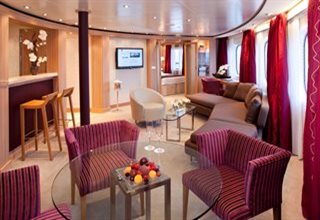
Category: O1
Suites on board feature a comfortable living area, private veranda, queen-size-bed or two twin beds; walk-in closet with personal safe, interactive flat-screen TV with music and movies, fully stocked bar and refrigerator, writing desk with personalized stationary, makeup vanity, spacious bathroom with separate tub and shower, plush robes, slippers, hair dryer, and 110/220V AC outlets.
- Owner's Suite (Category: O2)
Category: O2
Suites on board feature a comfortable living area, private veranda, queen-size-bed or two twin beds; walk-in closet with personal safe, interactive flat-screen TV with music and movies, fully stocked bar and refrigerator, writing desk with personalized stationary, makeup vanity, spacious bathroom with separate tub and shower, plush robes, slippers, hair dryer, and 110/220V AC outlets.
- Penthouse Spa Suite (Category: PS)
Category: PS
All Penthouse Suites on board feature a comfortable living area, glass door to private veranda, queen-size-bed or two twin beds; walk-in closet with personal safe, two flat-screen TV with music and movies, fully stocked bar and refrigerator, writing desk with personalized stationary, makeup vanity, spacious bathroom with separate tub and shower, plush robes, slippers, hair dryer, and 110/220V AC outlets.
Deck Plan

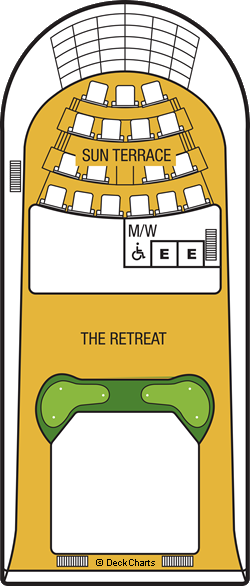
| Symbol | Description |
|---|---|
 | Wheelchair-accessible suite; roll-in shower only; wheelchair-accessible doorways; Suite 635 also has a tub |
 | Veranda railings are part metal and part glass from floor to teak rail |
 | Subject to noise when anchoring; has all-metal veranda railings, limiting the view |
 | Smaller veranda |
 | Third guest capacity suite |
 | Elevator |
 | Self service launderette |
 | Suite can be reached only via a staircase |
 | Partially obstructed veranda view |
Ship Facts
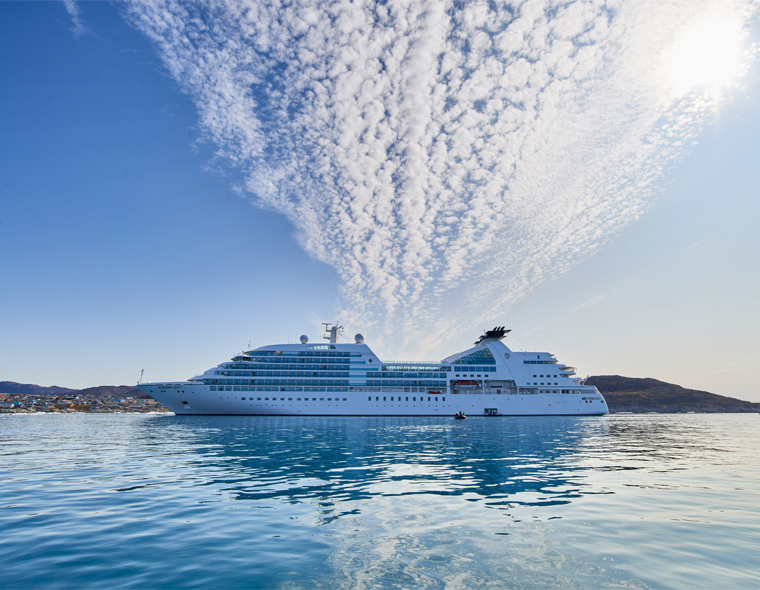
- Ship Name: Seabourn Quest
- Ship Name: Seabourn Quest
- Year Built: 2010
- Year Entered Present Fleet: 2011
- Ship Class: O
- Maximum Capacity: 458
- Number of Passenger Decks: 9
- Number of Crew: 295
- Officers' Nationality: International
- Tonnage (GRT): 32,000
- Capacity Based on Double Occupancy: 458
- Country of Registry: The Bahamas
- Total Staterooms: 229
- Crew/Hotel Staff Nationality: International
Costco Member Reviews
Available Dates and Prices
Terms & Conditions
*Price shown is per person based on double occupancy, is valid for select stateroom categories only and does include government taxes/fees and gratuities. Click on the Terms & Conditions link below for details.
**Select complimentary shore excursions are for full-fare guests only, capacity controlled and subject to availability. Shore excursion reservations are accepted on a first-come, first-served basis. Please note, available excursions vary by sailing date and day of the week. Government fees and taxes are included. Requested excursions may not be available at time of booking. Supplement will apply on Ventures by Seabourn®, optional shore excursions. Restrictions apply and penalties apply 36 hours prior to shore excursion start date.
†One Digital Costco Shop Card per room/stateroom, per stay. The exact amount of the Digital Costco Shop Card will be calculated during the booking process. The Digital Costco Shop Card promotion is nontransferable and may not be combined with any other promotion. A Digital Costco Shop Card will arrive by email approximately 10 days after the start of your cruise. Click on the Terms & Conditions link below for additional information.
Ship's registry: The Bahamas
Package ID: SBNQUESAM20281118
Digital Costco Shop Card
Book this cruise with Costco Travel and receive a Digital Costco Shop Card. The Digital Costco Shop Card is a convenient payment option in our warehouses and on Costco.com.