 Help Center

 United States
 Canada
 Australia
Coupon Override
Please Call
For drivers under the age of 25, additional fees and/or restrictions may apply.
For information and assistance in completing your reservation, please call:
1-866-921-7925Sorry
We're unable to find your location.

Europe and Mediterranean: Brilliant Bordeaux Cruise

All-Inclusive Cruise

True All-Inclusive Boutique River Cruising™
All gratuities for onboard services
Unlimited fine wine, beer, spirits and nonalcoholic beverages**
Shore excursions with local experts as your guide
Internet and Wi-Fi

Executive Member Benefit
Executive Members receive an annual 2% Reward, up to $1,250, on qualified Costco Travel purchases
Receive a EUR 50 shipboard credit per person (maximum EUR 100 per stateroom)♦

Digital Costco Shop Card
Member Exclusive: Digital Costco Shop Card with every Uniworld® river cruise†
Sailing Itinerary

Note: Cruise itineraries are subject to change. Please verify ports and times directly with the cruise line.

Overview


Visit a bottle of wine. It’s no secret. That’s what Bordeaux is known for and how you’ll likely spend your time in the world’s largest, premium wine district – savoring the wine and the sights. Bordeaux has long been synonymous with fine wines. Situated in the southwest of France in a graceful crescent along a bend in the Garonne River, you’ll find the region that delivers the full-bodied beverages known the world over. Connected to the Bay of Biscay and the Atlantic Ocean by the Gironde River (so wide it appears to be an inlet), the inland port of Bordeaux has been an important trading center since before the Roman era. (The city was founded in the 3rd century BC by a Celtic tribe.) Bordeaux became incredibly prosperous during the 18th century when the city was France’s most important port and a hub for trade to and from the New World. Though its shipping industry has since declined, Bordeaux continues to be a regional transportation center, and its good fortune continues today with wine exports totaling the equivalent of nearly $10 billion US dollars each year. It was the Romans – not the French – who planted the first grape vines along the Garonne River in the 1st century BC. Wine became the lifeblood of the region early on, and in many ways still is. Peak wine production in the 13th century produced export numbers that were not exceeded until the 1950s! The Bordeaux region is one of the largest purveyors of wine in the world, producing over half a billion bottles a year – more than 50% of France’s output. Area vineyards stretch to cover over 520 square miles producing wine that’s shipped to over 160 countries worldwide. No doubt, you’ve sampled more than a few of those bottles. Most of us have. But there is more to Bordeaux than wine. Most business and commercial areas are centered in the relatively small 18th-century downtown area. The buildings that line the quays present stunning examples of the architecture of the Siecle des Lumieres, the Century of Enlightenment. The Place de la Bourse typifies this elegant style, with its slate roof, lower-level arcades, and carved faces adorning the keystones of the arches. You can also visit the nearby Palais Gallien, a ruined Roman amphitheater; the Grand Theatre, the inspiration for the famed Paris Opera House; and the Musee des Beaux-Arts, which features an impressive collection of French paintings. But art and architecture are not the only things the French do well. Gourmet dining is a specialty here, so be sure to indulge in a grand dinner with fine regional wine. Gourmet shopping, of course, goes hand in hand with dining so take a stroll down the Rue Sainte Catherine, Porte Dijeaux, and the Course de Il’intendance, where you’ll find fresh foie gras, truffles, fine cheeses, and a broad selection of wines to enjoy right here or take home for later.
Overview

The largest town in the Medoc wine region, Pauillac, located on the Gironde River, is home to three of the top five Grand Crus. The Chateau Mouton-Rothschild, Chateau Lafite-Rothschild, and Chateau Latour can be visited by appointment; arrangements may be made directly through the wineries or by contacting the tourist office. From mid-July to mid-August, the tourist office offers free wine tasting one evening per week, featuring wines from 15 local chateaux.
Overview

Cadillac is a commune in the Gironde department in Aquitaine in southwestern France. Cadillac is directly across the Garonne River from Sauternes and is known for producing sweet dessert wines under the Cadillac AOC designation. Cadillac was founded in 1280 to serve as a river port for the castle of Benauges by the lord of the castle, Jean I de Grailly. Cadillac is the home of the imposing Château des Ducs d'Épernon. The name of the commune was adopted by Antoine Laumet de La Mothe, sieur de Cadillac, the founder of Detroit and Governor of Louisiana, on his arrival to what is now the United States. The Cadillac division of General Motors, and Cadillac, Michigan are named after him.
Overview

Blaye is a commune and subprefecture in the Gironde department in Aquitaine in southwestern France. Blaye is located on the right bank of the Gironde estuary (which is some 3 km (1.9 mi) wide at this point), close to the A10 autoroute, 56 km (35 mi) north of Bordeaux. There is a rail line with occasional freight trains, but no passenger services. A small ferry crosses the Gironde to Lamarque, in Medoc. In ancient times Blaye (Blavia) was a port of the Santones. Tradition states that the Frankish hero Roland was buried in its basilica, which was on the site of the citadel. It was early an and important stronghold that played an important part in the wars against the English (who burnt it in 1352) and the French Wars of Religion (when it was the site of a Spanish naval victory in 1593). The Duchess of Berry was imprisoned in its fortress in 1832-1833. The town was formerly named Blaye-et-Sainte-Luce and was renamed Blaye in June 1961. The town has a citadel built by Vauban on a rock beside the river, and embracing in its ancient ruins of an old Gothic château. The latter contains the tomb of Charibert II, king of Aquitaine, and son of Clotaire II. Blaye is also defended by the Fort Paté on an island in the river and the Fort Médoc on its left bank, both of the 17th century. The citadel of Blaye, its city walls, the Fort Paté, and the Fort Médoc (the latter in nearby Cussac-Fort-Médoc) were listed in 2008 as UNESCO World Heritage Sites, as part of the "Fortifications of Vauban" group.
Overview

Libourne (Gascon Liborna) is a commune in the Gironde department in Aquitaine in southwestern France. It is a sub-prefecture of the department. It is the wine-making capital of northern Gironde and lies near Saint-Émilion and Pomerol. In 1270, Leybornia was founded as a bastide by Roger de Leybourne (of Kent), an English seneschal of Gascony, under the authority of King Edward I of England. It suffered considerably in the struggles of the French and English for the possession of Gironde in the 14th century and joined France in the 15th century. The Gothic church, restored in the 19th century, has a stone spire 232 ft (71 m) high. On the quay there is a machicolated clock-tower which is a survival of the defensive walls of the 14th century; and the townhouse, containing a small museum and a library, is a quaint relic of the 16th century. It is located by the main square, the Place Abel Surchamp, which hosts every week end one of the largest fresh food markets in the region. There is a statue of Élie, duc Decazes, who was born in the neighborhood.
Overview
Libourne (Gascon Liborna) is a commune in the Gironde department in Aquitaine in southwestern France. It is a sub-prefecture of the department. It is the wine-making capital of northern Gironde and lies near Saint-Émilion and Pomerol. In 1270, Leybornia was founded as a bastide by Roger de Leybourne (of Kent), an English seneschal of Gascony, under the authority of King Edward I of England. It suffered considerably in the struggles of the French and English for the possession of Gironde in the 14th century and joined France in the 15th century. The Gothic church, restored in the 19th century, has a stone spire 232 ft (71 m) high. On the quay there is a machicolated clock-tower which is a survival of the defensive walls of the 14th century; and the townhouse, containing a small museum and a library, is a quaint relic of the 16th century. It is located by the main square, the Place Abel Surchamp, which hosts every week end one of the largest fresh food markets in the region. There is a statue of Élie, duc Decazes, who was born in the neighborhood.
Overview
Visit a bottle of wine. It’s no secret. That’s what Bordeaux is known for and how you’ll likely spend your time in the world’s largest, premium wine district – savoring the wine and the sights. Bordeaux has long been synonymous with fine wines. Situated in the southwest of France in a graceful crescent along a bend in the Garonne River, you’ll find the region that delivers the full-bodied beverages known the world over. Connected to the Bay of Biscay and the Atlantic Ocean by the Gironde River (so wide it appears to be an inlet), the inland port of Bordeaux has been an important trading center since before the Roman era. (The city was founded in the 3rd century BC by a Celtic tribe.) Bordeaux became incredibly prosperous during the 18th century when the city was France’s most important port and a hub for trade to and from the New World. Though its shipping industry has since declined, Bordeaux continues to be a regional transportation center, and its good fortune continues today with wine exports totaling the equivalent of nearly $10 billion US dollars each year. It was the Romans – not the French – who planted the first grape vines along the Garonne River in the 1st century BC. Wine became the lifeblood of the region early on, and in many ways still is. Peak wine production in the 13th century produced export numbers that were not exceeded until the 1950s! The Bordeaux region is one of the largest purveyors of wine in the world, producing over half a billion bottles a year – more than 50% of France’s output. Area vineyards stretch to cover over 520 square miles producing wine that’s shipped to over 160 countries worldwide. No doubt, you’ve sampled more than a few of those bottles. Most of us have. But there is more to Bordeaux than wine. Most business and commercial areas are centered in the relatively small 18th-century downtown area. The buildings that line the quays present stunning examples of the architecture of the Siecle des Lumieres, the Century of Enlightenment. The Place de la Bourse typifies this elegant style, with its slate roof, lower-level arcades, and carved faces adorning the keystones of the arches. You can also visit the nearby Palais Gallien, a ruined Roman amphitheater; the Grand Theatre, the inspiration for the famed Paris Opera House; and the Musee des Beaux-Arts, which features an impressive collection of French paintings. But art and architecture are not the only things the French do well. Gourmet dining is a specialty here, so be sure to indulge in a grand dinner with fine regional wine. Gourmet shopping, of course, goes hand in hand with dining so take a stroll down the Rue Sainte Catherine, Porte Dijeaux, and the Course de Il’intendance, where you’ll find fresh foie gras, truffles, fine cheeses, and a broad selection of wines to enjoy right here or take home for later.
Overview
Visit a bottle of wine. It’s no secret. That’s what Bordeaux is known for and how you’ll likely spend your time in the world’s largest, premium wine district – savoring the wine and the sights. Bordeaux has long been synonymous with fine wines. Situated in the southwest of France in a graceful crescent along a bend in the Garonne River, you’ll find the region that delivers the full-bodied beverages known the world over. Connected to the Bay of Biscay and the Atlantic Ocean by the Gironde River (so wide it appears to be an inlet), the inland port of Bordeaux has been an important trading center since before the Roman era. (The city was founded in the 3rd century BC by a Celtic tribe.) Bordeaux became incredibly prosperous during the 18th century when the city was France’s most important port and a hub for trade to and from the New World. Though its shipping industry has since declined, Bordeaux continues to be a regional transportation center, and its good fortune continues today with wine exports totaling the equivalent of nearly $10 billion US dollars each year. It was the Romans – not the French – who planted the first grape vines along the Garonne River in the 1st century BC. Wine became the lifeblood of the region early on, and in many ways still is. Peak wine production in the 13th century produced export numbers that were not exceeded until the 1950s! The Bordeaux region is one of the largest purveyors of wine in the world, producing over half a billion bottles a year – more than 50% of France’s output. Area vineyards stretch to cover over 520 square miles producing wine that’s shipped to over 160 countries worldwide. No doubt, you’ve sampled more than a few of those bottles. Most of us have. But there is more to Bordeaux than wine. Most business and commercial areas are centered in the relatively small 18th-century downtown area. The buildings that line the quays present stunning examples of the architecture of the Siecle des Lumieres, the Century of Enlightenment. The Place de la Bourse typifies this elegant style, with its slate roof, lower-level arcades, and carved faces adorning the keystones of the arches. You can also visit the nearby Palais Gallien, a ruined Roman amphitheater; the Grand Theatre, the inspiration for the famed Paris Opera House; and the Musee des Beaux-Arts, which features an impressive collection of French paintings. But art and architecture are not the only things the French do well. Gourmet dining is a specialty here, so be sure to indulge in a grand dinner with fine regional wine. Gourmet shopping, of course, goes hand in hand with dining so take a stroll down the Rue Sainte Catherine, Porte Dijeaux, and the Course de Il’intendance, where you’ll find fresh foie gras, truffles, fine cheeses, and a broad selection of wines to enjoy right here or take home for later.
Onboard the S.S. Bon Voyage
S.S. Bon Voyage
Costco Member Reviews

Year Built: 2006
Year Refurbished: 2019
Double Occupancy Capacity: 124
With her transformation, the S.S. Bon Voyage will debut a completely different look—including a redesigned top deck with an added swimming pool and lounge area, with an adjacent casual dining venue featuring lighter fare with a local spin and chef-led cooking classes. Inside, four new gorgeously-appointed suites will be introduced, as well as marble bathrooms throughout the ship, an enhanced dining room with an added chef demonstration area, and a new bistro inspired by Bouillon Pigalle in Paris. All finished perfectly in the unique and beautiful design aesthetic that Uniworld is known for, and paired with the addition of more crew members for a higher crew-to-guest ratio.
Onboard Activities
Activities & Services (included in cruise)
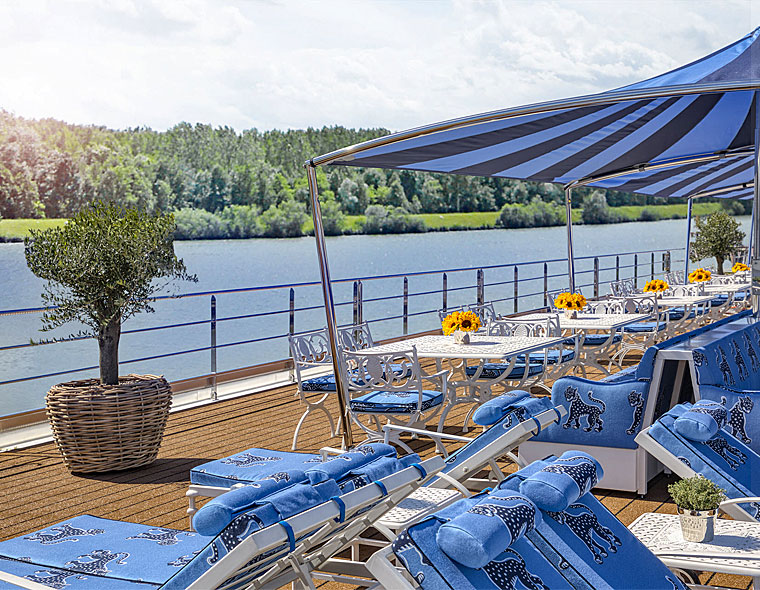
Sundeck
- Bars/Lounges
- Concierge Desk
- Culinary Arts Center
- Elevators
- Fitness Center
- Guest Lecturers
- Pool - Indoor/Covered
- Safe Deposit Boxes
Activities & Services (available for an extra fee)
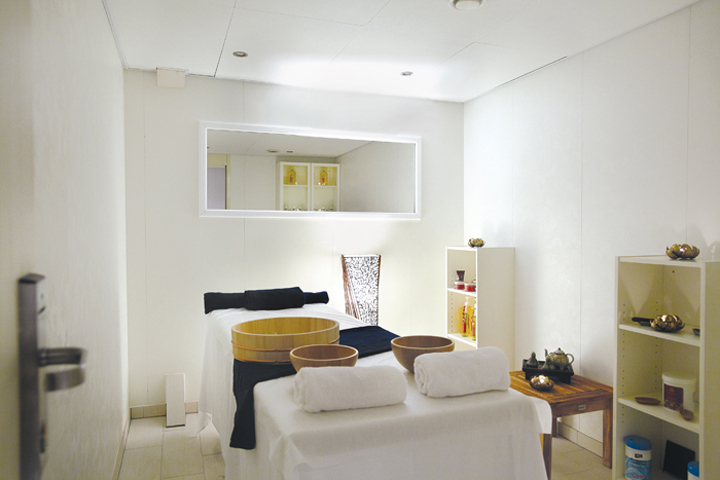
Spa
- Dry Cleaning/Laundry Service
- Spa Services/Massage
Dining
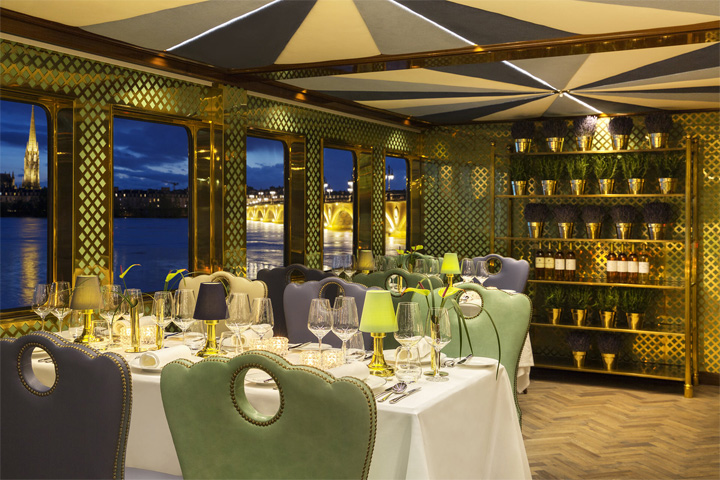
Main Dining
Main Restaurant (open seating): This seating option allows you to choose when and with whom you dine. Menus are a blend of classic cuisine with a touch of contemporary elegance, and are created using only the finest and freshest ingredients often brought onboard from local ports of call. You'll be surrounded by the beauty of passing riverbank towns and villages.
Specialty Dining
Casual Dining
All-Inclusive
- All Restaurants and Food Services are Complimentary
- Complimentary Beverages including Bottled Water and Soft Drinks
- Complimentary Concierge Services
- Complimentary Open Bar
- Complimentary Wine
- Onboard Gratuities
- Port Charges
Staterooms
- Classic Stateroom with Portholes (Category: CL)

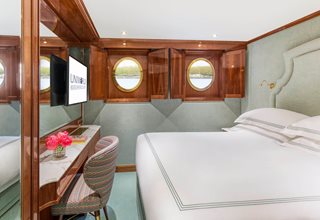
Category: CL
- Luxurious riverview stateroom
- 151 sq.ft – 14 sq.m
- Handcrafted Savoir® Beds of England, built-in closet, hair dryer, safe, individual thermostat, flat-screen TV with infotainment center
- Marble bathroom with Asprey bath and body products, plush towels, towel warmer, heated mirror, back-lit magnifying mirror, comfortable bathrobes and slippers
- Note: windows in these staterooms are situated at the water line
- Deluxe Stateroom with Window (Category: DE)
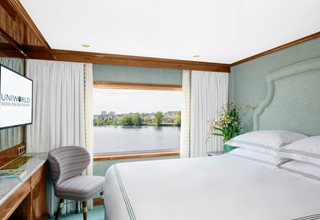
Category: DE
- Luxurious riverview stateroom
- 151 sq.ft – 14 sq.m
- Handcrafted Savoir® Beds of England, built-in closet, hair dryer, safe, individual thermostat, flat-screen TV with infotainment center
- Marble bathroom with Asprey bath and body products, plush towels, towel warmer, heated mirror, back-lit magnifying mirror, comfortable bathrobes and slippers
- Note that staterooms 201, 202, 230, and 231 have windows that are approximately 30% smaller than other Deluxe stateroom windows
- Stateroom with French Balcony (Category: FB)
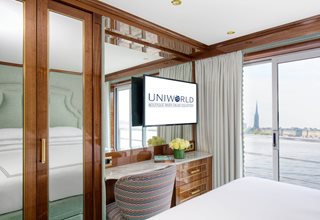
Category: FB
- Luxurious riverview stateroom (140 sq.ft – 13 sq.m) with a French balcony
- Handcrafted Savoir® Beds of England, built-in closet, hair dryer, safe, individual thermostat, flat-screen TV with infotainment center
- Marble bathroom with Asprey bath and body products, plush towels, towel warmer, heated mirror, backlit magnifying mirror, comfortable bathrobes and slippers
- Suite (Category: S)
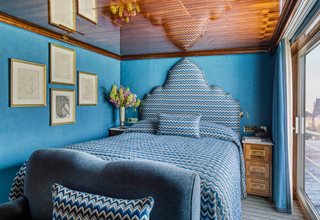
Category: S
- Luxurious riverview suite (210 sq.ft – 19.5 sq.m)
- Handcrafted Savoir® Beds of England, built-in closets, hair dryer, safe, individual thermostat and flat-screen TV with infotainment center
- Marble bathroom with Asprey bath and body products, plush towels, towel warmers, backlit magnifying mirror, heated mirrors, comfortable bathrobes and slippers
- Additional amenities and services include in-suite butler service, packing and unpacking assistance, in-room breakfast, daily fruit and cookie plate and an elegant evening snack, Nespresso coffee machine and fine teas, fully stocked mini bar, bottle of wine upon request, shoeshine, and free laundry service
- Grand Suite (Category: GS)
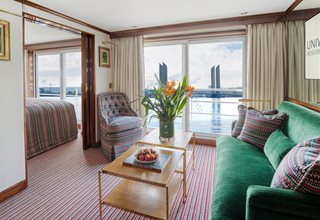
Category: GS
- Luxurious riverview grand suite (280 sq.ft – 26 sq.m) with a French balcony
- Grand Suites include handcrafted Savoir® Beds of England, built-in closets, hair dryer, safe, individual thermostat and flat-screen TV with infotainment center
- Marble bathroom with Asprey bath and body products, plush towels, towel warmer, comfortable bathrobes and slippers, a rain shower and tub, backlit magnifying mirror, heated mirror and a secluded toilet area
- Additional amenities and service include: in-suite butler service; packing and unpacking assistance; in-room breakfast; daily fruit and cookie plate, and an elegant evening snack; Nespresso coffee machine and fine teas; fully stocked mini bar; bottle of wine upon arrival; shoe shine; and free laundry service
Deck Plan
No information available.
Ship Facts
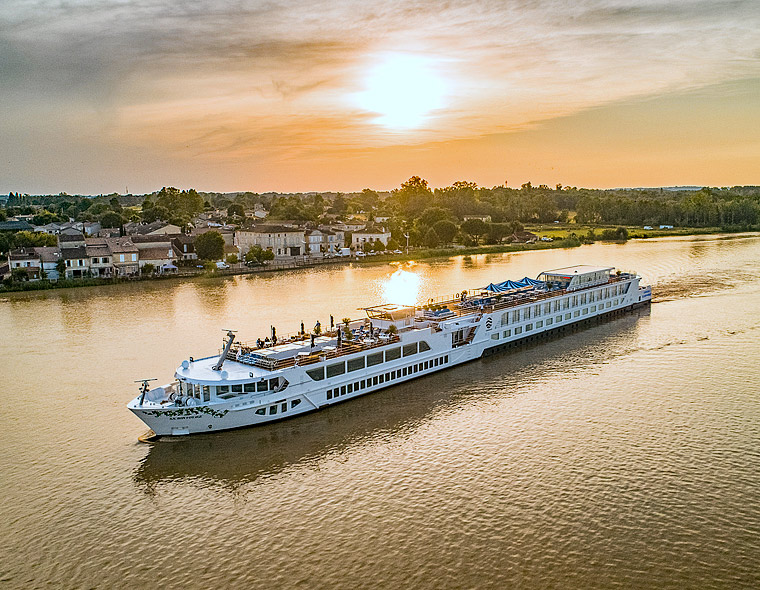
- Ship Name: S.S. Bon Voyage
- Ship Name: S.S. Bon Voyage
- Year Built: 2006
- Year Refurbished: 2019
- Year Entered Present Fleet: 2006
- Ship Class: River "Super Ship"
- Number of Passenger Decks: 3
- Number of Crew: 54
- Officers' Nationality: European/International
- Ocean-View without Balcony: 36
- Ocean-View with Balcony: 22
- Capacity Based on Double Occupancy: 124
- Country of Registry: The Netherlands
- Total Staterooms: 62
- Suites with Balcony: 4
- Crew/Hotel Staff Nationality: European/International
Costco Member Reviews
Available Dates and Prices
Terms & Conditions
*Price shown is per person based on double occupancy and is valid for select stateroom categories only. Click on the Terms & Conditions link below for details.
**Unlimited beverages include premium wine and premium spirits. Diamond List of wine and spirits is available at an additional cost.
◆Executive Members receive a EUR 50 shipboard credit per person, maximum EUR 100 per stateroom. Executive Member benefit is valid for primary cardholder only. Shipboard credit is per stateroom based on double occupancy. Shipboard credit will be applied to your onboard account. Any unused portion of the credit is nontransferable, nonrefundable and may not be redeemed for cash.
†One Digital Costco Shop Card per room/stateroom, per stay. The exact amount of the Digital Costco Shop Card will be calculated during the booking process. The Digital Costco Shop Card promotion is nontransferable and may not be combined with any other promotion. A Digital Costco Shop Card will arrive by email approximately 10 days after the start of your cruise. Click on the Terms & Conditions link below for additional information.
Ship's registry: The Netherlands
Package ID: UNIBONEUR20261025
Digital Costco Shop Card
Book this cruise with Costco Travel and receive a Digital Costco Shop Card. The Digital Costco Shop Card is a convenient payment option in our warehouses and on Costco.com.